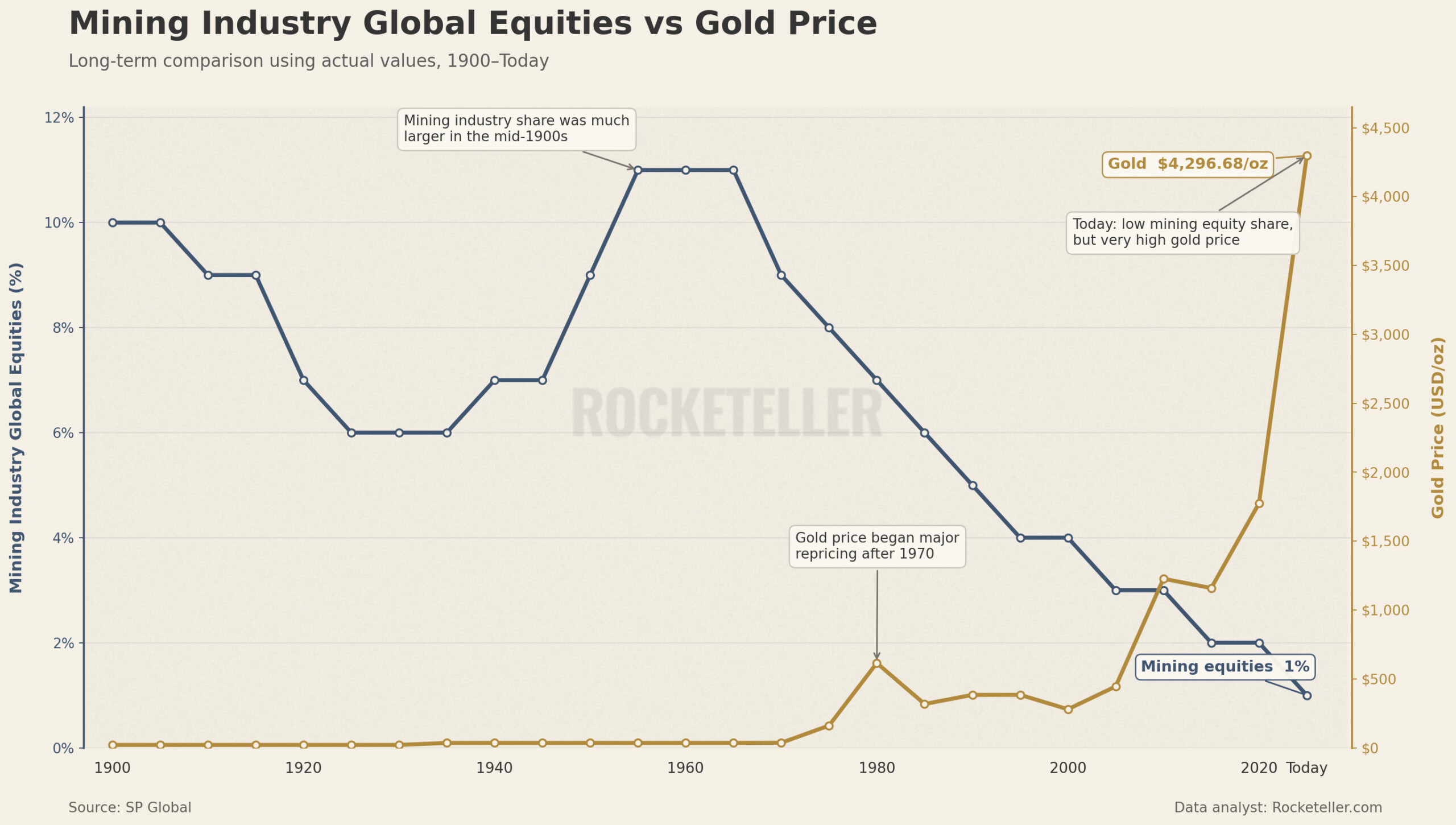
This chart tells a powerful story. Gold became dramatically more expensive, yet mining companies became dramatically less important inside the global equity market. In the mid 20th century, mining represented a much larger share of global equities. That made sense. The world was building cities, factories, railways, power systems and industrial capacity at scale. Commodity producers sat near the center of the economic machine.
Then the market changed. Technology, finance, healthcare and consumer businesses grew faster, while mining became a smaller slice of the stock market. At the same time, gold broke away from its old fixed-price system after the early 1970s. Once gold was free to reprice, inflation, currency debasement, geopolitical stress, falling real interest rates and monetary expansion allowed its nominal price to rise.
That creates today’s unusual setup. Gold is extremely valuable, but mining equities remain a tiny part of market capitalization.
For commodity investors, that gap matters. When commodity prices rise faster than mining costs, producer margins can expand quickly. Higher cash flow improves balance sheets, dividends, exploration spending and investor appetite. Because the mining sector is now small, even a modest rotation of global capital into resource equities can have an outsized impact on valuations.
But the sequence matters. High gold prices alone do not guarantee a mining boom. Costs, grades, permitting, debt and capital discipline still decide the winners. If strong metal prices spread into copper, silver, energy and other raw materials, this divergence could become the foundation of a broader commodity equity re-rating.