Theta Gold Mines Limited ASX: TGM
Introduction
Theta Gold Mines Limited is an Australian-listed gold developer advancing the TGME Gold Project near Pilgrim’s Rest in Mpumalanga, South Africa. Through its wholly owned South African subsidiary, Theta holds 74% of TGME and Sabie Mines, with the remaining interests held by empowerment partners. The company continues to report approximately 6.1 million ounces of gold resources across its portfolio.
The investment case centres on rebuilding production in an established goldfield. Historic workings and infrastructure provide a foundation, while the new processing plant is intended to turn several deposits into a coordinated mining operation. The strongest attraction is the combination of underground grades, favourable modeled operating costs and exploration potential. The central challenge is delivering those economics while servicing debt and managing a large share base.
Theta deserves attention as a potential emerging producer. Its investment quality will increasingly depend on construction completion, successful commissioning and actual operating results.
Projects / Location / MRE / Grades
Project 1: TGME Gold Project, Mpumalanga, South Africa – Flagship Development Asset
TGME is the core development project. Its revised plan incorporates Beta, Frankfort, Clewer-Dukes Hill-Morgenzon-CDM-and Rietfontein, together with surface material.
The investment logic is a central processing facility supplied by several mines. This can spread infrastructure costs across multiple deposits, although coordinating their development and ore delivery adds operating complexity.
Mineral Resource Estimate
Portfolio-wide resource
The February 2021 estimate provides the detailed basis for the approximately 6.1 Moz headline still cited by Theta.
| Resource category | Tonnes | Gold grade | Contained gold |
| Measured | 0.091 Mt | 5.37 g/t | 15,700 oz |
| Indicated | 18.128 Mt | 2.84 g/t | 1,652,500 oz |
| Inferred | 27.267 Mt | 5.06 g/t | 4,437,000 oz |
| Total, as reported | 45.485 Mt | 4.17 g/t | 6,105,200 oz |
Figures are on a 100% basis, include reserves and may differ slightly through rounding. Measured and indicated resources must remain distinct from inferred resources. Approximately 73% of the headline ounces are inferred, calculated from the reported categories.
The resource is substantial, but resource size alone does not establish economic mineability. Conversion, access, mining losses, dilution and recovery determine how much can become saleable gold.
Underground resources supporting the development projects
The February 2026 study restates the following underground resource totals, using diluted stope tonnes and grades:
| Category | Stope tonnes | Stope grade | Contained gold |
| Measured | 0.091 Mt | 5.37 g/t | 15,700 oz |
| Indicated | 4.543 Mt | 6.24 g/t | Approximately 912,000 oz |
| Measured + indicated, reported total | 4.634 Mt | 6.22 g/t | Approximately 927,000 oz |
| Inferred | 7.736 Mt | 5.56 g/t | Approximately 1,383,200 oz |
These underground figures are a subset of the wider portfolio and must not be added to the 6.1 Moz headline.
TGME Feasibility Economics
Theta’s revised study contains two different cases. The longer Base Case includes inferred resources, the Ore Reserve Plan provides a higher-confidence comparison.
| Study metric | Base Case | Ore Reserve Plan |
| Mine life | 13.1 years | 8.8 years |
| Gold contained in scheduled feed | Approximately 1.011 Moz | Approximately 604,000 oz |
| Recovered gold | Approximately 871,000 oz | Approximately 514,000 oz |
| Feed grade | 4.96 g/t | 4.82 g/t |
| Average recovery | 86.2% | 85.2% |
| After-tax NPV₁₀ | US$455M | US$220M |
| After-tax IRR | 77% | Approximately 52% |
The revised reserve totals approximately 3.895 Mt at 4.82 g/t for 604,000 contained ounces. Contained ounces are different from recovered production.
Additional Base Case economics:
| Metric | Disclosed value |
| Average modeled gold price | US$2,884/oz |
| AISC | US$1,181/oz |
| Total initial capital | Approximately US$102M |
| Peak funding requirement | Approximately US$77M |
| Cumulative after-tax project FCF | Approximately A$1.413B |
| Payback from start of mining | Approximately 29 months |
| Plant capacity | 540,000 tonnes annually |
Peak funding is not total initial capital. Cash generated during development can reduce the maximum external funding requirement. These figures are forecasts, not achieved operating results.
TGME Grade Feel
The underground resource grades support an attractive investment case. However, narrow mineralised reefs require careful control of the material mined around them.
Investors should focus on reconciled plant feed grade rather than the highest geological reef grade. The economic result depends on how much waste enters the mining stream and how consistently the plant recovers gold.
Project 2: Wider Eastern Transvaal Goldfield – District Optionality
Theta describes a landholding of approximately 620 km² encompassing 43 historical mines. Additional opportunities include Vaalhoek and Glynn’s Lydenburg. Some website descriptions retain older development sequencing, so the revised study should govern the current core mine plan.
The district offers possible future feed sources, mine-life extensions and exploration discoveries. A successful central plant could make nearby deposits more useful by reducing the need for separate processing infrastructure.
However, historical workings are not automatically profitable future mines. Each addition requires geological verification, technical studies, approvals and capital.
Project 3: Surface Resources and Other Development Options
The company’s resource disclosures also cover open-pit, tailings and rock-dump material. The earlier Theta open-pit resource reported approximately 917,400 oz at 2.99 g/t, including indicated and inferred categories. This is an older estimate and forms part of the wider portfolio rather than additional ounces beyond it.
Surface material could assist commissioning or provide supplementary feed. Its value depends on recovery, processing cost and availability.
Share Structure / Ownership / Insiders
Capital Structure
| Metric | Figure and disclosure basis |
| Ordinary shares | 1,337,136,337 in the 10 August 2026 Appendix 2A |
| Options and performance rights | Approximately 261.87M, calculated from that filing |
| Fully diluted shares on that basis | Approximately 1,599.01M |
| Later indicative ordinary share count | Approximately 1.38B in a September data snapshot |
| Rounded valuation denominator | 1.60B fully diluted shares |
| Verified cash balance | US$13.3M at 30 June 2026 |
| Current cash balance | Not verified; affected by subsequent funding and spending |
The August securities figures come from the company filing. The later ordinary count is secondary-source information and should be reconciled before publication; 1.60B is a rounded modeling denominator, not a certified current register. A reference price of A$0.185, reported around 1 October, implies approximately A$296M on the modeled fully diluted share base. This is a calculation using a dated reference price, not a live market quotation.
Ownership / Insiders
The June 2026 presentation showed the following expected post-placement ownership, rather than a verified October register:
| Ownership group | Presented interest |
| Hong Kong Ruihua group | 15.56% |
| 2invest AG + Deutsche Balaton | 6.77% |
| Chengtun Mining | 6.17% |
| Directors and management | Approximately 11% |
These interests should not automatically be added into a single insider percentage, beneficial interests may overlap. Strategic shareholders provide useful support. Their presence does not eliminate dilution, and strategic holdings should remain distinct from management’s personal economic exposure.
People / Management
Bill Guy, Executive Chairman
Exploration and resource-development experience, including leadership at Bligh Resources and Longford Resources and an exploration role at Jupiter Mines.
Bill Richie Yang , Executive Director
Corporate finance and capital-structuring background across junior exploration and mining development.
Byron Dumpleton , Non-Executive Director
Geological and operating experience associated with St Ives, Telfer, Nifty and the Kalgoorlie Super Pit.
Brett Tang , Non-Executive Director
Legal, fund-management and mining-investment background.
Hansjörg Plaggemars , Non-Executive Director
Corporate finance and debt-structuring experience; represents the Deutsche Balaton/Delphi/Sparta investor group.
Ching Iu , Non-Executive Director
Chengtun representative with international mining-investment and corporate-finance experience.
Jacques Du Triou , Chief Operating Officer
South African mining experience across construction, commissioning and operations, including Harmony and Qmotion Mining.
Brent Hofman , CFO / Company Secretary
ASX corporate finance, reporting and governance experience.
Operations and Sustainability Team
Freddy Moketla brings underground production experience from Harmony. Terrence Mokale covers community engagement, while Puselatso Matete contributes environmental and governance experience.
Risks / Catalysts / Timeline
Key Risks
| Risk | Why it matters |
| Construction and commissioning | Incomplete equipment, infrastructure or integration can delay cash generation. |
| Underground execution | Historic workings require dependable access, ground control, ventilation and water management. |
| Resource conversion | The longer Base Case depends on inferred material becoming sufficiently understood for mining. |
| Grade and dilution | Additional waste or lower delivered grades can materially reduce margins. |
| Metallurgy | Recovery may vary between deposits and surface feed sources. |
| Cost escalation | Study AISC must be demonstrated under actual operating conditions. |
| Debt service | Interest and repayment obligations continue even if production disappoints. |
| Dilution | Additional equity can reduce shareholders’ participation in project upside. |
| Permitting and environment | Mine-specific approvals, water conditions and rehabilitation obligations require ongoing compliance. |
| South African operating conditions | Power, security, labour relations and community support affect continuity. |
| Currency | Changes in the rand influence US-dollar costs; AUD/USD affects reported valuation. |
| Gold price | Sustained prices below the modeled scenarios would reduce cash flow and value. |
| Ownership and cash distributions | Minority interests and funding arrangements affect cash reaching the listed parent. |
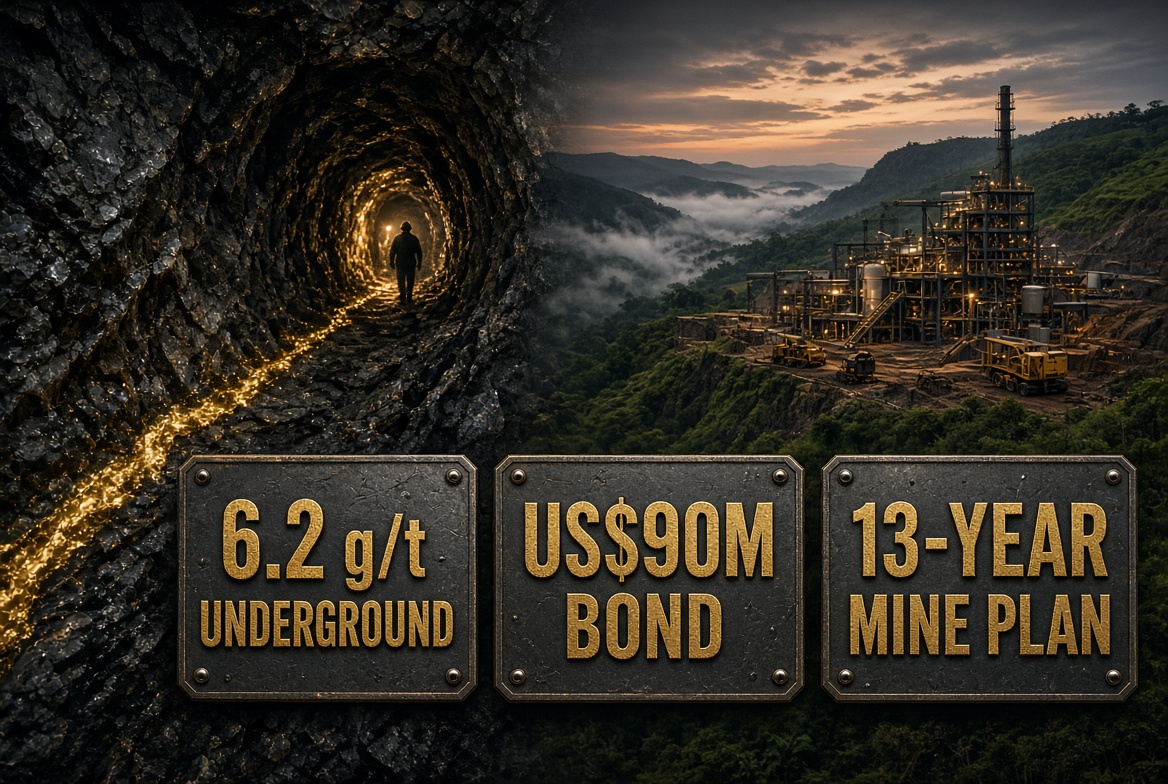
The bond carries a 12.75% annual coupon, a four-year tenor and a discounted issue price. On US$90M face value, the coupon equates to US$11.475M annually, calculated before other financing costs.
Catalysts
| Timing | Milestone to monitor |
| Achieved September 2026 | First US$37M bond drawdown |
| Remainder of 2026 | Plant installation, infrastructure completion and testing |
| Q4 2026 target | Commissioning |
| Q1 2027 target | First gold |
| 2027 onward | Production ramp-up, grade reconciliation and cost reporting |
| Longer term | Resource conversion, satellite studies and potential expansion |
The initial bond drawdown is verified. Remaining bond releases are conditional, including cost-to-complete tests. Commissioning and first-gold dates are company targets.
Expected Timeline to Full Production
| Period | Focus | Investment significance |
| Late 2026 | Complete and commission the operation | Converts construction progress into an operating plant |
| 2027 | Establish production | Tests whether forecasts translate into recovered ounces |
| 2028 onward | Improve consistency and service debt | Determines the quality of shareholder cash generation |
| Longer term | Expand resources and feed sources | Could extend asset life if supported by studies |
The largest potential rerating comes from consistent profitable production. First gold is an important milestone, but sustained output is the stronger evidence.
Valuation
Project / Asset Valuation Treatment
| Asset | Treatment |
| TGME revised Base Case | Core project FCF sensitivity |
| Surface feed already scheduled | Included in core; no additional value |
| Vaalhoek and Glynn’s Lydenburg | Assumed optionality |
| Other district targets | Assumed optionality |
| Additional open-pit/surface opportunities | Assumed optionality only where outside the core model |
Optionality Value Assumptions
The following are analyst assumptions for Theta’s attributable interests, not company valuations:
| Optionality asset | Conservative | Base | Aggressive |
| Vaalhoek / Glynn’s Lydenburg | A$5M | A$15M | A$30M |
| Other district opportunities | A$5M | A$10M | A$25M |
| Additional open-pit / surface options | A$0M | A$5M | A$15M |
| Total | A$10M | A$30M | A$70M |
The main table uses A$30M, equivalent to A$0.01875 per modeled diluted share. These allowances compensate for possible future development opportunities. They should be reduced if subsequent work shows duplication with the core plan or unattractive economics.
All-Projects Valuation Table
For this illustrative enterprise-value bridge:
Equity indication = attributable project FCF × multiple + A$30M optionality − A$136.24M bond principal.
The debt conversion uses US$0.6606 per A$1, consistent with the study’s valuation framework, rather than current FX.
| Gold scenario | Average attributable project FCF | Multiple | Core indication | Optionality | Debt deduction | Equity indication | Per modeled diluted share |
| US$6,000 | A$227.59M | 10× | A$2.276B | A$30M | A$136.24M | A$2.170B | A$1.36 |
| US$6,000 | A$227.59M | 15× | A$3.414B | A$30M | A$136.24M | A$3.308B | A$2.07 |
| US$6,000 | A$227.59M | 20× | A$4.552B | A$30M | A$136.24M | A$4.446B | A$2.78 |
| US$7,000 | A$274.82M | 10× | A$2.748B | A$30M | A$136.24M | A$2.642B | A$1.65 |
| US$7,000 | A$274.82M | 15× | A$4.122B | A$30M | A$136.24M | A$4.016B | A$2.51 |
| US$7,000 | A$274.82M | 20× | A$5.496B | A$30M | A$136.24M | A$5.390B | A$3.37 |
Summary & Quick Scorecard
| Category | Points | Overall |
| Company Overview | Stock ticker: ASX: TGM Main metal: Gold Project phase: Advanced developer / construction-stage gold project Projects country: South Africa | — |
| 1. Management | Previous successful project, discovery, mine build, or company sale: Yes, relevant prior project-development experience within the team; TGME delivery remains unproven Exploration to development experience: Yes Big mining company experience: Yes, includes Harmony experience Capital markets track record: Yes | Strong |
| 2. Projects | High grades: Yes, underground measured and indicated resources average approximately 6.22 g/t gold MRE size: Yes, approximately 6.1 Moz across the portfolio, predominantly inferred Optionality: Yes, additional historical mines and district targets | Strong |
| 3. Cost Structure | Low AISC: Yes, modeled US$1,181/oz in the revised Base Case; not yet demonstrated operationally Low capex / Existing infrastructure: Existing infrastructure: Yes; total initial capital approximately US$102M, with peak funding approximately US$77M | Strong |
| 4. Share Structure Discipline | Fully diluted shares: Approximately 1,600,000,000 used in the model Fully diluted market cap: Approximately A$296M at the reference price of A$0.185; approximately US$195.5M using the model’s AUD/USD rate of 0.6606 | Strong |
| 5. Insider / Ownership | Insider ownership: Directors and management approximately 11% Hong Kong Ruihua group ownership: Approximately 15.56% 2invest AG + Deutsche Balaton ownership: Approximately 6.77% Chengtun Mining ownership: Approximately 6.17% Total insider aligned ownership: 39% | Strong |
| 6. Location | Country: South Africa Tier: Tier 2, provisional analytical classification Province: Mpumalanga District: Eastern Transvaal / Sabie–Pilgrim’s Rest Goldfield | Good |
RT Rating, Commentary
Theta Gold Mines is a on our watchlist. 5 out of 5 stars.
Theta offers an attractive combination of underground grade, favourable modeled costs and a large goldfield capable of supporting future growth. The financing milestone improves its ability to complete development.
The bull case depends on successful commissioning, controlled dilution, reliable recovery and sufficient cash generation to service debt. If those conditions are demonstrated, the market could assign greater value to the production platform and its surrounding deposits.
The main restraint is financial and operational execution. The share structure is large, but the FD still strong, debt is expensive, and the longer mine plan includes inferred resources. And their project located in Tier 2. Those factors need to be extra careful, else this company looks great.
Join RockeTeller
At RockeTeller, we research mining stocks through a consistent checklist covering management, projects, costs, ownership, location and development progress.
We examine the questions that determine investment quality: Can the project generate cash, what assumptions support its valuation, and how much of that value could reach shareholders?
For detailed mining research, watchlist updates and clear valuation scenarios, subscribe to RockeTeller.com.