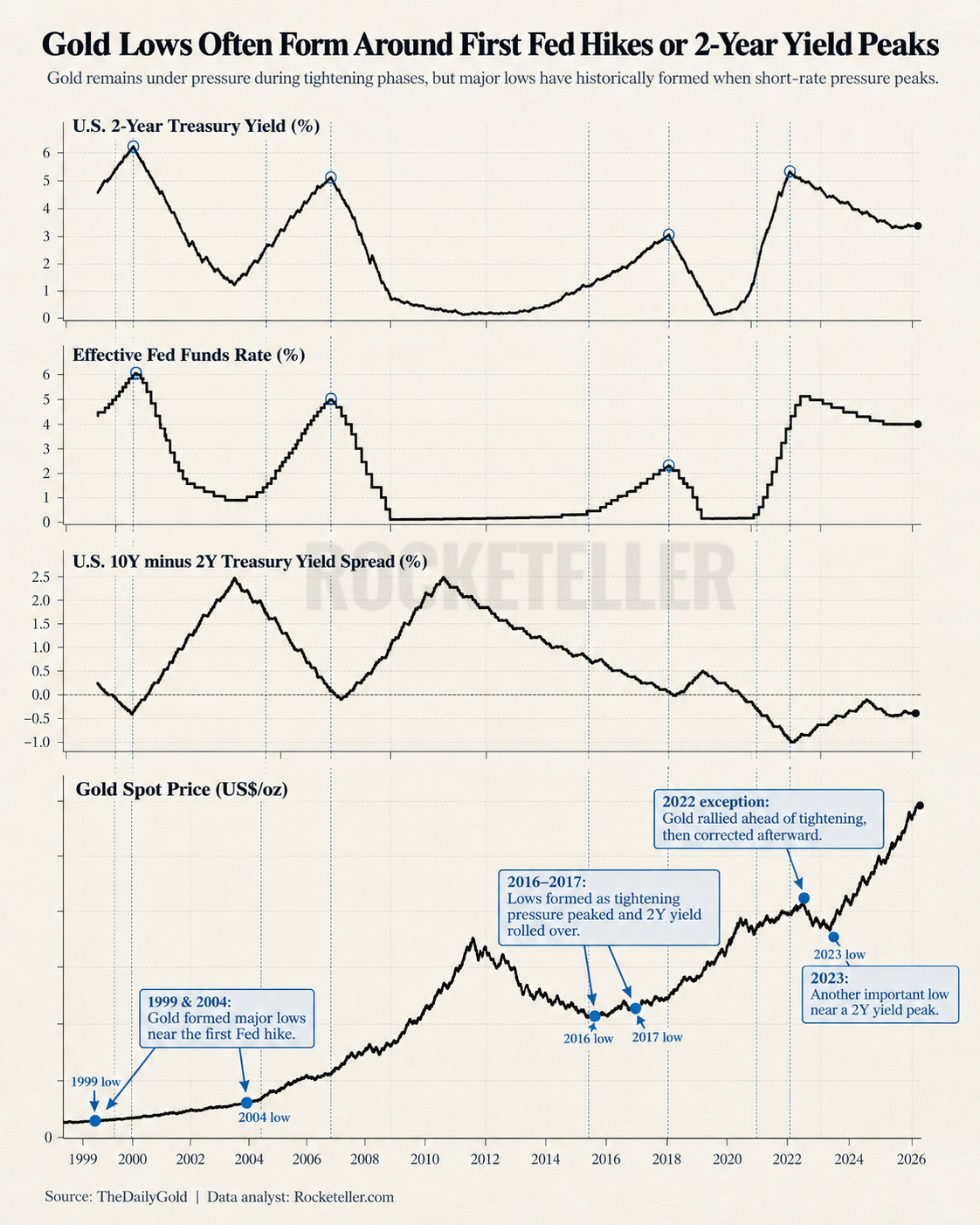
What this chart is really showing is a battle between gold and the price of money.
When the Federal Reserve tightens policy, short-term yields rise, real borrowing costs increase, liquidity becomes more expensive, and gold suddenly has competition. Gold does not pay interest. Treasury bills do. That is why gold often struggles while the 2-year yield is climbing and markets are still pricing tighter monetary policy.
But the interesting part comes near the end of that process.
Across several cycles, major gold lows formed when the pressure from short-term rates was close to reaching its maximum. In 1999 and 2004, gold bottomed around the beginning of Fed tightening. The 2016 and 2017 lows developed around periods when rate expectations were becoming heavily priced in. In 2023, gold again found an important low near a peak in the 2-year yield. The 2022 cycle was different. Gold rallied before aggressive tightening arrived, then corrected once the Fed accelerated rate hikes.
That matters far beyond gold. The 2-year Treasury yield is effectively the market’s live scoreboard for where monetary policy is heading. When it stops rising, the macro environment can begin shifting from tighter liquidity toward slower growth, easier policy expectations and eventually lower real-rate pressure.
That transition can become a powerful tailwind for commodities. Gold normally reacts first because it is highly sensitive to rates and liquidity. Silver can follow with greater volatility. Later, if lower rates weaken the dollar and economic expectations stabilize, industrial commodities such as copper can begin participating. The key signal is not simply that the Fed stops hiking. It is when the market starts believing the tightening cycle has done its job.