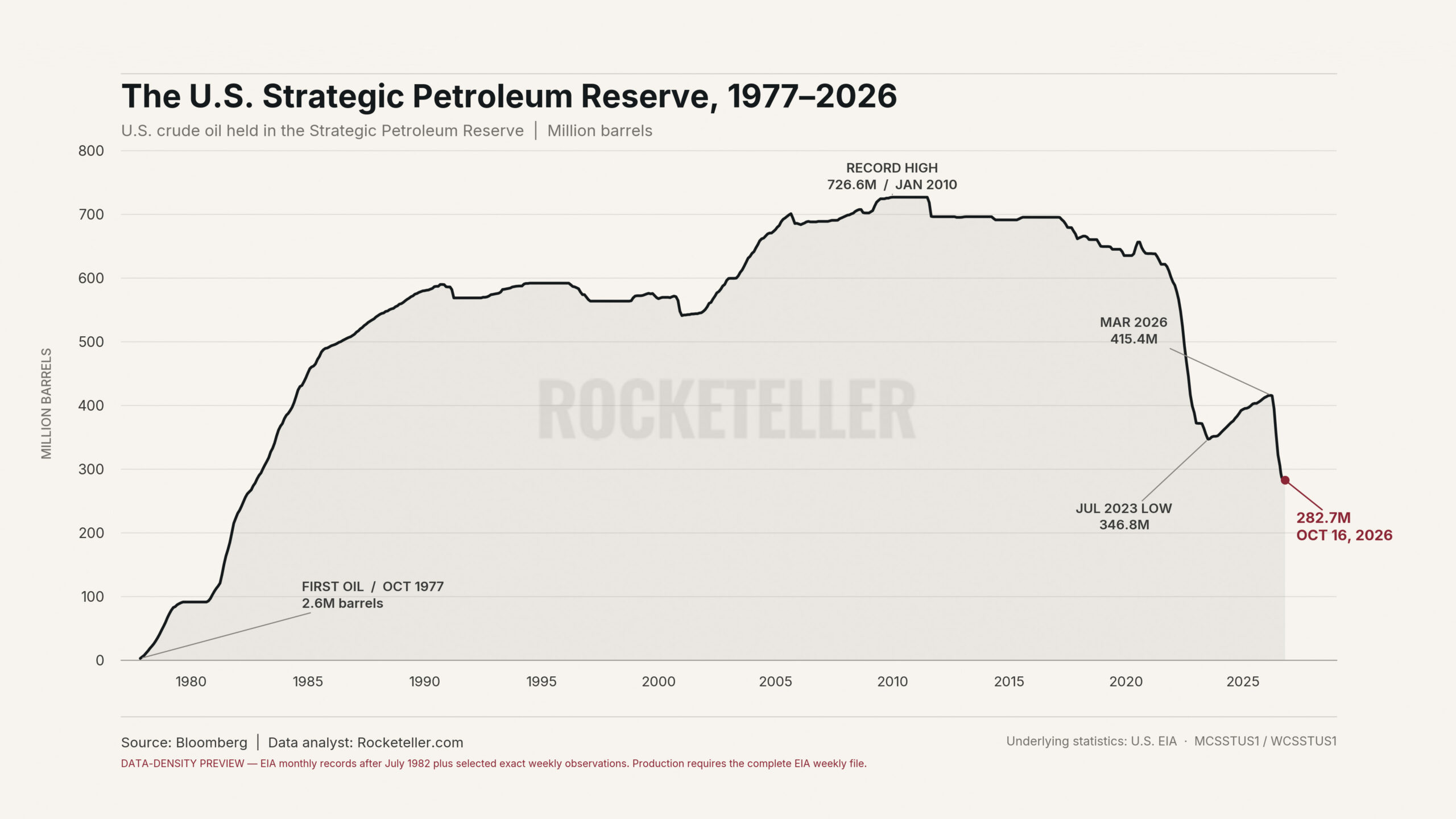
What you’re looking at is the U.S. Strategic Petroleum Reserve (SPR), America’s emergency oil stash that was created after the 1973 oil crisis. Think of it as the world’s largest oil piggy bank, designed to cushion the blow when supply disruptions hit. The chart tells a dramatic story. After decades of building up this reserve to a peak of 726.6 million barrels in 2010, we’re now witnessing a historic drawdown. The SPR has plummeted to just 282.7 million barrels as of October 2026, that’s a 61% drop from its peak.
Why does this matter for commodity markets? The SPR has been America’s secret weapon against oil price shocks. When hurricanes hit the Gulf Coast or geopolitical tensions flare, the government could tap this reserve to stabilize prices. With the reserve now at critically low levels, that safety net is essentially gone.
This creates a perfect storm for oil markets. Any supply disruption whether from Middle East tensions, natural disasters, or production cuts will now have a much more dramatic impact on prices. The market has lost its shock absorber, meaning we’re likely to see more volatility and potentially higher prices when the next crisis hits.
The depletion of the SPR represents a fundamental shift in global oil dynamics, removing a key stabilizing force that has helped moderate price swings for decades.
This ripple effect extends beyond oil into precious and industrial metals. Without the SPR cushion, oil price volatility could spike during supply disruptions, potentially driving inflation higher. This scenario typically sends investors flocking to gold as the ultimate safe haven. Silver would likely follow gold’s trajectory, though its industrial ties might temper gains. Copper faces a more complex dynamic, higher oil prices could pressure industrial activity and demand, yet copper’s inflation hedge properties might offset some weakness. The net effect could be a divergence between precious metals and industrial metals.