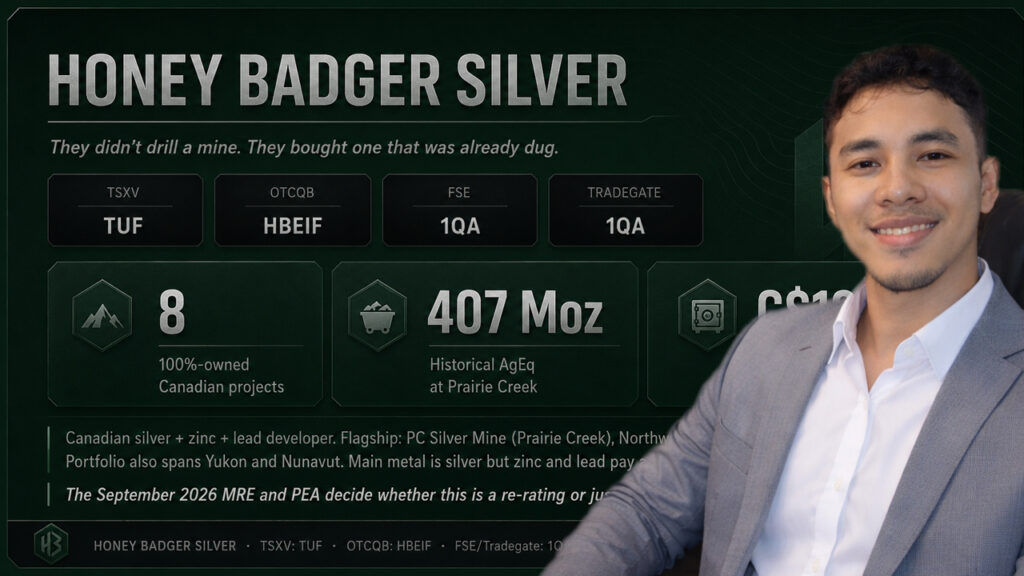
Honey Badger Silver Inc. TSXV: TUF / OTCQB: HBEIF / FSE: 1QA / Tradegate: 1QA
Introduction
Honey Badger Silver Inc. is a Canadian silver and critical-minerals development company with a portfolio of eight 100%-owned projects across the Northwest Territories, Yukon and Nunavut. The company changed materially in April 2026 when it acquired 100% of Canadian Zinc Corporation and its Prairie Creek property, now branded the PC Silver Mine, from Resource Capital Fund VI. Honey Badger paid approximately C$10 million in cash plus 12.5 million units, while completing a C$11.5 million equity financing associated with the transaction.
The PC Silver Mine is now clearly the main investment story. This is no longer just a collection of early-stage Canadian silver exploration properties. Honey Badger now controls a historically advanced silver-zinc-lead underground mine in the Northwest Territories with approximately five kilometres of existing underground workings, an existing mill and substantial surface infrastructure, more than 80,000 metres of historical drilling, an airstrip, roads and significant historical capital already invested. Management describes Prairie Creek as an almost completely developed historical mine and is trying to restart it as quickly and capital-efficiently as possible.
The biggest attraction is grade. The historical 2021 estimate contained 9.755Mt of measured and indicated material grading 139 g/t silver, 9.7% zinc and 8.8% lead, equivalent to roughly 240Moz AgEq at 766 g/t AgEq. An additional 6.403Mt of inferred material graded 150 g/t silver, 12.9% zinc and 6.7% lead, equivalent to roughly 167Moz AgEq at 813 g/t AgEq. Those are exceptionally high polymetallic grades. However, there is an important technical distinction, Honey Badger is not currently treating the 2021 estimate as a current mineral resource. An updated MRE and PEA are expected in September 2026.
The bull case is straightforward. Honey Badger acquired a high-grade, heavily developed Canadian mine at what appears to be a relatively low acquisition cost compared with the historical capital invested in the property. The existing infrastructure, high grades, long historical mine plan, large polymetallic inventory, strong Canadian jurisdiction and potential critical-mineral credits from germanium and other metals create substantial leverage if management can validate the resource and produce attractive updated economics.
The risk is equally important. Investors are currently relying heavily on historical resource and economic data. The 2021 Prairie Creek PEA is approximately five years old, used much lower metal prices but also older capital and operating-cost assumptions, and was prepared for the previous owner. Honey Badger must now demonstrate through its September 2026 studies that the resource remains technically supportable and that the economics still work after updating capex, operating costs, infrastructure requirements and financing assumptions. Until that occurs, this remains an advanced restart/development thesis rather than a fully de-risked producing-mine story.
Projects / Location / MRE / Grades
Project 1: PC Silver Mine / Prairie Creek, Northwest Territories Flagship Asset
Main Asset
The PC Silver Mine, historically known as Prairie Creek, is Honey Badger Silver’s flagship project and by far its most important asset. Honey Badger acquired 100% ownership in April 2026 through the purchase of Canadian Zinc Corporation from Resource Capital Fund VI.
The project is a high-grade underground silver-zinc-lead polymetallic system in the Northwest Territories. Previous owners invested hundreds of millions of dollars into underground development, processing infrastructure and surface facilities. Honey Badger’s August 2026 presentation describes approximately five kilometres of underground workings, a 1,000 tpd existing mill with historical permitting allowing expansion toward 2,400 tpd, an airstrip, roads, power solutions and extensive historical mine development.
An especially important part of the thesis is that Prairie Creek is a brownfield restart, not a greenfield mine where everything must be built from zero. Previous development reduces some technical and capital barriers, although substantial rehabilitation, infrastructure work, engineering and financing will still be required.
Grade Feel
Prairie Creek is exceptionally high grade on a silver-equivalent basis.
The historical measured and indicated estimate averaged approximately:
- 139 g/t silver
- 9.7% zinc
- 8.8% lead
- approximately 766 g/t AgEq
Historical inferred material averaged:
- 150 g/t silver
- 12.9% zinc
- 6.7% lead
- approximately 813 g/t AgEq
The grade becomes even more impressive inside the Main Quartz Vein. Historical measured and indicated material in that domain averaged approximately 184 g/t silver, 11.9% lead and 10.7% zinc, equivalent to roughly 950 g/t AgEq.
This is the main reason Prairie Creek deserves attention. Many undeveloped silver projects require very large tonnage to compensate for moderate grades. Prairie Creek is the opposite. Its economic concept depends on relatively high-value underground ore feeding a comparatively modest-sized processing operation and producing zinc concentrate plus a silver-rich lead concentrate.
Important Historical-Resource Warning
The Prairie Creek figures below originate from the October 15, 2021 NI 43-101 technical report prepared for NorZinc, the former parent of Canadian Zinc.
Honey Badger explicitly states that a qualified person has not yet done sufficient work to classify these historical estimates as current mineral resources, and the company is therefore not treating them as current mineral resources. Significant data compilation, verification, re-sampling or additional drilling may be required.
This distinction is critical. The September 2026 updated MRE should become the first major test of how much of the old resource survives under Honey Badger’s current technical work.
PC Silver Mine Historical Resource Summary
| Resource Category | Tonnes | Ag Grade | Pb Grade | Zn Grade | AgEq Grade | Contained AgEq |
| Measured | 1.031Mt | 193 g/t | 10.3% | 12.6% | 969 g/t | 32.1Moz |
| Indicated | 8.724Mt | 133 g/t | 8.6% | 9.4% | 743 g/t | 208.3Moz |
| Measured + Indicated | 9.755Mt | 139 g/t | 8.8% | 9.7% | 766 g/t | 240.4Moz |
| Inferred | 6.403Mt | 150 g/t | 6.7% | 12.9% | 813 g/t | 167.5Moz |
The historical estimate therefore contains approximately 407.9Moz of total AgEq between M&I and inferred categories. In actual silver rather than AgEq, the tonnes and reported grades imply roughly 43.6Moz of silver in M&I and another 30.9Moz in inferred material before considering the substantial zinc and lead value.
This is one reason it is misleading to evaluate Prairie Creek as a pure silver deposit. Zinc and lead make up a major portion of the contained economic value.
Historical 2021 PEA Legacy Economic Benchmark
The last published economic study was the 2021 Prairie Creek PEA completed for NorZinc. It should be treated as a historical benchmark rather than current Honey Badger guidance.
Key 2021 figures included:
| Item | 2021 PEA |
| Mine life | 20.3 years |
| Processing rate concept | 2,400 tpd |
| Average payable silver | 2.551Moz/year |
| Average payable zinc | 122Mlb/year |
| Average payable lead | 101Mlb/year |
| After-tax NPV8 | C$299M |
| After-tax IRR | 17.7% |
| Initial capex | C$368M |
| Sustaining + closure capex | C$332M |
| Payback | 4.8 years |
| LOM after-tax FCF | C$1.121B |
| Average annual EBITDA | C$123M |
| Silver assumption | US$24/oz |
| Zinc assumption | US$1.20/lb |
| Lead assumption | US$1.05/lb |
The study also reported life-of-mine C1 by-product costs of approximately US$0.19/lb zinc and C3 by-product costs of US$0.60/lb zinc. Because Prairie Creek is polymetallic and the old study reported costs primarily on a zinc-equivalent basis, it is not appropriate to simply label Prairie Creek with a modern silver AISC without a new study.
The old PEA is interesting because it generated positive economics using only US$24 silver. However, investors should not assume that simply inserting a much higher silver price into the old model gives today’s project value. Labour, construction, fuel, logistics, equipment and financing costs have also changed materially since 2021.
Existing Infrastructure
The project already has major infrastructure that would normally represent a large portion of a greenfield mine’s development budget:
- approximately five kilometres of underground workings;
- existing mill infrastructure;
- airstrip;
- surface roads;
- power-related infrastructure;
- existing camp and mine facilities;
- extensive historical drilling;
- a completed winter road;
- planned approximately 170 km all-season road access.
The company’s current presentation states that more than C$300 million has been invested since the 1980s and elsewhere describes total historical investment as exceeding C$500 million depending on what expenditures are included. The basic conclusion is the same: Honey Badger acquired a property containing a very substantial amount of sunk development capital.
Permitting Feel
Honey Badger describes Prairie Creek as fully permitted and highlights existing First Nations benefit agreements. The all-season access road is also described as permitted, with road-management planning continuing.
For our analysis, we would still avoid interpreting “fully permitted” as meaning that absolutely no further regulatory work will ever be required. A restart, revised mine plan, construction changes or updated engineering can still require amendments, construction approvals, operating authorizations and ongoing environmental compliance.
The more important conclusion is that Prairie Creek appears far more advanced from a permitting and stakeholder standpoint than the average junior-development project.
Indigenous Relationships
Prairie Creek has a long history of engagement with Indigenous communities. The previous owner completed updated benefit arrangements, and Honey Badger is continuing engagement with Indigenous governments while developing its restart strategy.
This is important because infrastructure, particularly the all-season road, and the mine restart itself require durable local relationships. Management currently identifies Indigenous-government engagement as one of its major ongoing priorities.
Critical-Mineral Optionality
Prairie Creek is becoming more than a silver-zinc-lead story.
Research involving the University of Toronto and Northwest Territories Geological Survey identified germanium values of up to approximately 316 ppm in early-stage testing within the Stratabound Massive Sulphide zone. Germanium is a strategically important critical mineral used in semiconductor, optical and defence applications.
The company is also discussing copper, antimony and potentially other critical-mineral credits.
This optionality should not yet be inserted into a formal valuation because no current resource or recovery study establishes payable germanium production. However, it could become strategically important if future work confirms sufficient grade, continuity, recovery and concentrate payability.
Latest Technical Work / Drilling
Honey Badger’s immediate 2026 work is focused less on aggressive new drilling and more on validating and re-engineering the historical asset.
The current priorities are:
- updated Mineral Resource Estimate;
- updated Preliminary Economic Assessment;
- optimization of the mine plan;
- optimization of capital requirements;
- evaluation of operating strategy;
- concentrate-marketing and offtake discussions;
- potential strategic partners;
- non-dilutive financing alternatives;
- additional critical-mineral work.
The company expects the updated MRE and PEA in September 2026.
That September study is the single most important near-term catalyst for the stock.
Project 2: Sunrise Lake, Northwest Territories High-Grade Resource Optionality
Sunrise Lake is located approximately 130 kilometres northeast of Yellowknife and covers six contiguous mining leases totaling approximately 1,621 hectares.
The deposit is an Archean-hosted polymetallic VMS system containing silver, zinc, lead, copper and gold. The historical resource remains open along strike and down-dip, giving the property additional exploration potential.
Sunrise Lake Historical Resource
| Category | Tonnes | Ag | Zn | Pb | Cu | Au | Contained Ag |
| Indicated | 1.522Mt | 262 g/t | 6.0% | 2.4% | 0.08% | 0.67 g/t | 12.8Moz |
| Inferred | 2.555Mt | 169 g/t | 4.4% | 1.9% | 0.07% | 0.51 g/t | 13.9Moz |
These are again historical estimates, originally prepared in 2003, and Honey Badger does not treat them as current mineral resources.
Grade Feel
Sunrise Lake is attractive on grade.
An indicated silver grade of 262 g/t combined with 6% zinc, 2.4% lead and gold credit gives this deposit meaningful polymetallic value. Even the historical inferred material at 169 g/t silver is respectable.
If Honey Badger eventually converts Sunrise Lake into a current NI 43-101 resource, it could become a meaningful second development asset behind Prairie Creek.
For now, would classify Sunrise Lake primarily as high-quality optionality, because management’s capital and technical attention is clearly concentrated on Prairie Creek.
Project 3: Plata, Yukon High-Grade Exploration Optionality
Plata is a 100%-owned district-scale polymetallic property in Yukon. Recent claim additions expanded the land package to approximately 10,156 hectares.
The project sits roughly 165 km east of the historic Keno Hill silver district and approximately 30 km from Snowline Gold’s Rogue discovery. More than 30 mineralized targets have been identified across the district-scale system.
Grade Feel
Plata contains some extremely high-grade historical silver results.
Important historical results include:
- P-4: average 1.9m grading approximately 337 g/t Ag, 3.65 g/t Au, 1.59% Pb and 1.7% Zn across 14 historical drill holes;
- P-3: 1.96m grading approximately 2,383 g/t Ag, 9.85 g/t Au and 7% Pb;
- P-6: 1.0m grading approximately 1,655 g/t Ag and 1.09% Zn;
- P-6: 6.63m grading approximately 164 g/t Ag and 2.34% Zn.
Historic production also demonstrated exceptionally high silver grades.
Critical-Mineral Upside
Recent work expanded the Plata thesis beyond silver and gold. Honey Badger has identified antimony, copper and tungsten mineralization, giving the project additional critical-mineral optionality.
Plata therefore offers several exploration paths:
- high-grade silver-gold veins;
- lead-zinc polymetallic mineralization;
- antimony;
- copper;
- tungsten;
- potential intrusive-related mineralization.
There is no current MRE, PEA or mine plan. Plata should therefore be treated as exploration optionality rather than included directly in our core Prairie Creek valuation.
Project 4: Nanisivik, Nunavut Past-Producing District Optionality
Nanisivik is located on northern Baffin Island near Arctic Bay, Nunavut.
The historical Nanisivik Mine produced approximately 17.9 million tonnes of ore and more than 20Moz of silver, in addition to roughly five billion pounds of zinc, before closing in 2002 during a weaker commodity-price environment.
Infrastructure
The district benefits from unusual Arctic infrastructure, including:
- road access;
- nearby air facilities;
- deep-water port infrastructure.
That is strategically important because infrastructure is often the biggest weakness of northern Canadian exploration projects.
Exploration Upside
Recent geophysics identified multiple untested conductors underneath and around previously mined areas.
Highlighted historical or recent results include:
- Oceanview North: approximately 97.6 g/t Ag and 22.8% Zn over 5.3m;
- Area 14: approximately 280 g/t Ag and 27.4% Zn over 2.3m;
- surface grab samples up to approximately 249 g/t Ag and 51.5% Zn.
Germanium / Pyrite Optionality
Honey Badger is also investigating large pyrite-rich bodies for potential commercial uses and critical-metal content, including germanium, gallium and indium.
This is speculative at this stage, but Nanisivik’s combination of historical production, existing infrastructure, very large sulphide systems and untested geophysical targets makes it a potentially valuable longer-term option.
There is no current compliant MRE that should be used in valuation today.
Project 5: Clear Lake, Yukon Historical Zinc-Silver Resource
Clear Lake is a SEDEX-style zinc-lead-silver deposit approximately 225 kilometres north of Whitehorse.
The property has a Class 3 Land Use Approval valid until 2029, allowing significant future drilling activity.
Clear Lake Historical Resource
| Category | Tonnes | Ag | Zn | Pb | Contained Ag | Contained Zn | Contained Pb |
| Historical Inferred | 7.76Mt | 22 g/t | 7.6% | 1.08% | 5.5Moz | 1.3Blb | 185Mlb |
This estimate was prepared by SRK in 2010 and is historical. Honey Badger is not treating it as a current mineral resource.
Grade Feel
Silver grade is modest at approximately 22 g/t, so Clear Lake is fundamentally more of a zinc-rich polymetallic deposit than a pure silver project.
Historical drilling nevertheless produced impressive widths, including approximately:
- 29m at 14.1% Zn, 2.24% Pb and 36.4 g/t Ag;
- 6.3m at 20.9% Zn, 8.3% Pb and 101 g/t Ag.
Clear Lake adds another potentially significant zinc-silver asset to the portfolio but is unlikely to compete with Prairie Creek for capital in the near term.
Project 6: Yava, Nunavut Historical Polymetallic Resource
Yava is a 100%-owned polymetallic project in Nunavut located relatively close to the Hackett River district.
A 1970s historical estimate outlined approximately 1.3Mt grading 4.96% Zn, 1.60% Pb, 1.03% Cu, 3.42 oz/t silver and 0.008 oz/t gold.
The historical estimate cannot be relied upon as a current mineral resource and would require verification drilling, re-sampling and modern geological modelling.
Grade Feel
Despite its age, the historical estimate indicates a potentially high-value polymetallic system.
The combination of zinc, lead, copper and silver is attractive, but Yava remains a secondary exploration asset. It receives no material value in our core valuation until the company completes enough work to establish a modern resource.
Project 7: Hy, Yukon High-Grade Exploration Property
Hy is a road-accessible exploration property in Yukon containing numerous silver-lead-zinc showings plus several critical minerals.
Historical trenching produced results including approximately:
- 684 g/t silver, 9.3% zinc and 11.1% lead over 1.83m;
- approximately 370 g/t silver with high lead and zinc grades over broader intervals.
Historical drilling has also intercepted high-grade polymetallic mineralization.
More recent geological review has identified additional potential for:
- indium;
- bismuth;
- tungsten;
- copper;
- tellurium.
There is no MRE.
Hy should therefore be viewed as inexpensive exploration optionality rather than an asset currently driving Honey Badger’s valuation.
Project 8: Groundhog, Yukon Early-Stage High-Grade Optionality
Groundhog is an early-stage Yukon silver-gold property.
The project contains approximately 18 known high-grade silver and gold showings but has not undergone systematic diamond drilling.
Historic surface samples have returned spectacular grades, including individual rock samples exceeding 11,000–13,000 g/t silver. Historical bulk sampling also produced very high silver grades.
These numbers are eye-catching but should not be confused with representative deposit grades. Grab samples and isolated surface results are highly selective.
Groundhog is essentially a free exploration option within the broader portfolio today.
Share Structure / Ownership / Insiders
Capital Structure
Honey Badger’s August 2026 corporate presentation provides the following approximate capital-position snapshot as of July 31, 2026:
| Capital Structure Item | Approximate Amount |
| Basic shares outstanding | 227.0M |
| Options | 15.9M |
| Warrants | 95.0M |
| Estimated fully diluted shares | 337.9M |
| Share price used by company | C$0.70 |
| Basic market capitalization | C$158.9M |
| Debt | C$0 |
| Estimated cash | C$4.0M |
| Physical silver | 10,261 oz |
| Approx. physical-silver value | C$1.0M |
| Enterprise value | C$153.9M |
The company presentation also shows Chad Williams owning approximately 34.8M shares or 15.3%, Eric Sprott approximately 17.8M shares or 7.8%, and Blue Moon Metals approximately 1.9%.
Future Financing Strategy
Management is explicitly investigating:
- government funding;
- project debt;
- base-metal streams;
- concentrate offtake;
- prepayment structures;
- strategic partners;
- other non-dilutive or less-dilutive financing alternatives.
This is important. If a large portion of the restart capex can be funded through government infrastructure support, zinc/lead streaming, debt or offtake, equity dilution could be materially lower than a conventional all-equity junior mine build.
Ownership / Insider
Chad Williams
Chad Williams owns approximately 15.3% of the basic shares based on the company’s July 31 presentation.
That is meaningful insider alignment. A 15% ownership position is large enough that the CEO’s financial outcome is strongly connected to shareholders.
Eric Sprott
Eric Sprott owns approximately 7.8% based on the same company presentation.
Sprott’s participation is not the same as management insider ownership, but it adds credibility from a precious-metals-investor standpoint and creates an additional strategically aligned large shareholder.
Overall insider aligned at 25%.
Physical Silver Position
Honey Badger has another unusual asset: physical silver.
The company invested 10,000 ounces of physical silver through a Monetary Metals arrangement carrying a stated 12% annual yield payable in physical silver. By mid-2026 the company reported holding approximately 10,261 ounces.
This is not large enough to drive the company’s valuation, but strategically it is interesting.
It provides:
- direct silver exposure;
- a small source of physical-silver income;
- an asset outside the exploration/development portfolio;
- alignment with management’s bullish silver thesis.
We would treat it as a small balance-sheet bonus rather than a core reason to own the stock.
People / Management
Chad Williams
Executive Chairman & CEO
Chad Williams has extensive capital-markets and mining-finance experience.
He is the founder and Chairman of Red Cloud Mining Capital, founder of Honey Badger Silver and Sharechest, co-founder of Agilith Capital and Westwind Capital, former CEO of Victoria Gold, and former Head of Mining Investment Banking at Blackmont Capital.
Earlier in his career, he was a top-ranked mining analyst at TD Bank and other Canadian brokerage firms. He holds engineering and MBA qualifications from McGill University.
Williams is probably Honey Badger’s biggest corporate strength.
The next phase of Prairie Creek will require capital structuring as much as geology. Honey Badger needs to negotiate with governments, banks, smelters, offtakers, streamers and strategic investors.
That fits Williams’ background extremely well.
He also founded and later sold Mines D’Or Orbec, giving him direct experience with corporate exits and transactions.
The risk is that his expertise is more heavily weighted toward capital markets than personally operating underground mines. That is why the appointment of Ron Halas is important.
Ron Halas, P.Eng.
Chief Operating Officer
Ron Halas has more than 35 years of mining-industry experience covering open-pit and underground operations, mine design, construction, commissioning and technical leadership.
His previous experience includes senior roles with:
- Lumina Gold;
- Kinross Gold;
- IAMGOLD;
- Vale;
- Placer Dome;
- Inco.
He has worked across the full mine-development cycle from feasibility through construction, commissioning and steady-state operations.
Andrew Jedemann
Vice President, Exploration
Andrew Jedemann is a geologist with exploration experience in northwestern Ontario covering gold, nickel-copper and PGE systems.
He has helped manage more than 20,000 metres of drilling at Barrick’s Hemlo mine and worked on new target generation in Ontario’s Ring of Fire region.
He is also acting as a qualified person for current technical disclosure relating to Prairie Creek.
Robert Suttie
Chief Financial Officer
Robert Suttie has more than 20 years of accounting and financial-reporting experience, including approximately ten years in public accounting.
He specializes in public-company accounting and financial disclosure and serves as CFO for multiple junior issuers.
Michael Jalonen
Director
Michael Jalonen spent approximately 34 years as a mining research analyst, including roughly 33 years with Bank of America Securities.
He specialized in precious metals, visited more than 100 mining and development projects globally and built detailed mine-by-mine financial models across senior and intermediate precious-metals companies.
Justin Cochrane
Technical / Capital Markets & M&A Advisor
Justin Cochrane has more than 20 years of experience in finance, royalty and streaming structures, corporate strategy and capital markets.
He previously held senior roles with Sandstorm Gold, Cobalt 27 and Nickel 28 and has been involved in more than US$5 billion of M&A and capital-markets transactions.
Risks / Catalysts / Timeline
Key Risks
| Risk Category | Key Risk |
| Historical Resource Risk | Prairie Creek’s large 2021 estimate is currently classified by Honey Badger as historical rather than a current mineral resource. The September 2026 MRE must validate it. |
| Historical PEA Risk | The 2021 PEA is not a current Honey Badger economic study. Costs, mine design and assumptions need updating. |
| Capex Inflation Risk | The old PEA required C$368M initial capex. Inflation and infrastructure requirements could push today’s number higher even with existing facilities. |
| Infrastructure Rehabilitation Risk | The mill, underground workings and other facilities are historical. Existing infrastructure has value but may require significant rehabilitation or replacement. |
| All-Season Road Risk | Prairie Creek remains a remote northern project. Construction and execution of permanent road access are important to reliable operations. |
| Arctic / Northern Logistics | Fuel, equipment, contractors, weather and transportation can increase both operating and capital costs. |
| Financing Risk | Restarting Prairie Creek could require hundreds of millions of dollars depending on the updated PEA. |
| Dilution Risk | Honey Badger already has a large warrant overhang following 2026 financings. Additional common-equity funding could significantly increase the share count. |
| Concentrate-Marketing Risk | Prairie Creek intends to produce zinc and silver-rich lead concentrates. Smelter terms, penalties, transport costs and payable-metal assumptions matter. |
| Metallurgical Risk | Polymetallic concentrates are more complex than simple silver doré production. |
| Commodity-Mix Risk | Prairie Creek is not pure silver. Zinc and lead prices materially influence economics. |
| Permitting / Amendment Risk | Although the project is advanced and management describes it as fully permitted, changes to mine design or infrastructure may require additional approvals or amendments. |
| Indigenous / Community Risk | Continued strong Indigenous relationships remain essential to access, infrastructure and long-term operation. |
| No Current Reserve | Historical resources and PEA mine plans do not equal current proven or probable reserves. |
| Execution Risk | Honey Badger must transition rapidly from asset acquisition into engineering, financing, rehabilitation, construction and ultimately operations. |
| Management-Bandwidth Risk | Eight projects create optionality but also the potential for capital and management distraction. |
| Critical-Mineral Speculation Risk | Germanium, antimony and other by-product upside should not be assigned material value until grade, recovery and payability are demonstrated. |
Catalysts
| Timeline | Catalyst |
| September 2026 | Updated Prairie Creek Mineral Resource Estimate |
| September 2026 | Updated Prairie Creek Preliminary Economic Assessment |
| September 2026 | New capex estimate |
| September 2026 | Updated operating-cost assumptions |
| September 2026 | Updated mine plan and production profile |
| September 2026 | Updated NPV, IRR and payback |
| September 2026 | Clarity on how much of the historical resource converts to current NI 43-101 resources |
| Late 2026 | Further optimization of capital and operating strategy |
| Late 2026 | Potential concentrate-marketing / offtake agreements |
| Late 2026–2027 | Potential strategic partner discussions |
| Late 2026–2027 | Government / infrastructure funding discussions |
| 2027 | Potential debt, stream, prepayment or project-finance discussions |
| 2027 | Engineering and mine-restart planning |
| 2027 onward | Underground rehabilitation and infrastructure work if financed |
| Medium Term | Additional Prairie Creek resource expansion / verification drilling |
| Medium Term | Further germanium and other critical-mineral evaluation |
| Medium Term | Sunrise Lake resource-conversion work |
| Medium / Long Term | Plata, Nanisivik and other portfolio drilling |
The September 2026 MRE/PEA is by far the most important catalyst. Management has confirmed that both studies remain expected in September.
Expected Timeline to Production
| Timeline | Expected Progress Toward Production |
| 2026 | Complete updated MRE and PEA, establish modern capex/opex estimates, determine optimized restart strategy, continue offtake and financing discussions. |
| 2027 | If the PEA is strong, advance detailed engineering, financing, road strategy, infrastructure rehabilitation planning, permit amendments if required and potentially begin major restart work. |
| 2028 | Potential construction / rehabilitation period depending on financing and engineering progress. |
| 2028–2029+ | Possible commissioning / production window under a successful accelerated restart scenario. |
A precise production date would currently be speculative.
Prairie Creek is much more advanced than a normal undeveloped project because substantial underground and surface infrastructure already exists. But an updated PEA has not yet been published and the project is not currently under full construction.
Valuation
Important Valuation Note
Honey Badger is in an unusual position.
It has a historical PEA, but that PEA is from 2021 and belongs to the previous technical framework. Meanwhile, the updated Honey Badger PEA is expected within weeks.
Therefore we should separate:
- Historical 2021 economics — useful as a benchmark.
- Illustrative high-silver valuation sensitivity — useful for understanding torque.
- September 2026 PEA — should become the real valuation anchor once published.
We should not present the valuation below as official company guidance.
Legacy 2021 PEA Benchmark
Using only the historical 2021 economics:
- After-tax NPV8: C$299M
- Initial capex: C$368M
- After-tax IRR: 17.7%
- Payback: 4.8 years
- Mine life: 20.3 years
- Annual payable silver: 2.551Moz
- Annual payable zinc: 122Mlb
- Annual payable lead: 101Mlb
- LOM after-tax FCF: C$1.121B
At the company’s July 31, 2026 basic market capitalization of approximately C$159M, the stock was trading significantly below the old PEA’s C$299M after-tax NPV.
However, this comparison is only directional because both the capital structure and project economics have changed materially since 2021.
CAD Share Price Sensitivity
Honey Badger’s current project does not have a published silver AISC.
For consistency with our silver-stock template, the following sensitivity uses a hypothetical US$35/oz effective FCF cost assumption.
This is not Prairie Creek guidance.
It deliberately simplifies a silver-zinc-lead polymetallic project into a silver-margin model so we can measure silver-price torque on a comparable basis.
Assumptions
| Assumption | Value |
| Fully Diluted Shares | 337.9M |
| CAD/USD Conversion | 1.37 |
| Illustrative AISC / FCF Cost | US$35/oz |
| Silver Price Case 1 | US$150/oz |
| Silver Price Case 2 | US$200/oz |
| Historical Prairie Creek payable silver | ~2.551Moz/year |
FCF Margin Assumption
| Silver Price | Illustrative Cost | FCF Margin / oz |
| US$150 | US$35 | US$115 |
| US$200 | US$35 | US$165 |
Again, Prairie Creek is polymetallic. Zinc, lead and possibly germanium credits could materially change real margins in either direction once the new PEA is available.
CAD Share Price Target Production Sensitivity
| Annual Production | Silver Price | Annual FCF | 10× FCF CAD/share | 15× FCF CAD/share | 20× FCF CAD/share |
| 2Moz | US$150 | US$230M | C$9.33 | C$13.99 | C$18.65 |
| 2Moz | US$200 | US$330M | C$13.38 | C$20.07 | C$26.76 |
| 2.551Moz | US$150 | US$293.4M | C$11.89 | C$17.84 | C$23.79 |
| 2.551Moz | US$200 | US$420.9M | C$17.07 | C$25.60 | C$34.13 |
| 3Moz | US$150 | US$345M | C$13.99 | C$20.98 | C$27.98 |
| 3Moz | US$200 | US$495M | C$20.07 | C$30.10 | C$40.14 |
| 5Moz | US$150 | US$575M | C$23.31 | C$34.97 | C$46.63 |
| 5Moz | US$200 | US$825M | C$33.45 | C$50.17 | C$66.90 |
The 2.551Moz/year row is especially relevant because that was the average payable silver production in the historical 2021 Prairie Creek PEA.
However, these numbers are intentionally aggressive. They assume the full silver-price-minus-cost margin becomes FCF and do not properly model:
- taxes;
- royalties;
- zinc and lead revenue;
- treatment charges;
- refining charges;
- concentrate transport;
- rehabilitation capex;
- debt interest;
- sustaining capital;
- government funding;
- streams;
- future dilution;
- changes in recovery;
- higher inflation at very high metal prices.
They are therefore silver leverage scenarios, not price targets.
Summary & Quick Scorecard
| Category | Assessment | Overall |
| Company Overview | Stock ticker: TSXV:TUF / OTCQB:HBEIF / FSE:1QA / Tradegate:1QA. Main metal: Silver with major zinc and lead exposure. Main project: PC Silver Mine, NWT. Project phase: Advanced development / brownfield restart. Projects located entirely in Canada. | — |
| 1. Management | Previous successful project/company transaction: Yes. Exploration-to-development experience: Yes. Big mining-company experience: Yes. Strong capital-markets track record: Yes. Operating/mine-building capability strengthened significantly by Ron Halas. | Strong |
| 2. Projects | High grades: Yes, exceptionally high at Prairie Creek on historical AgEq basis. MRE size: Historically yes, but current MRE pending September 2026. Optionality: Yes, seven additional Canadian projects. | Strong |
| 3. Cost Structure | Low AISC: Unknown on silver basis until new PEA. Historical zinc costs were competitive. Existing infrastructure: Yes, major advantage. Initial capex: historically C$368M and therefore not low; updated figure required. | Good |
| 4. Share Structure Discipline | Basic shares approximately 227M; fully diluted approximately 337.9M. Still under $200M market cap. | Strong |
| 5. Insider / Ownership | Chad Williams approximately 15.3%; Eric Sprott approximately 7.8%. Insider alignment is at 25%. | Strong |
| 6. Location | Northwest Territories, Yukon and Nunavut, Canada. Tier-1 sovereign jurisdiction, although northern logistics increase execution complexity. | Strong |
RT Rating, Commentary
Honey Badger Silver is on our watchlist.
We rate this as 5 out of 5 stars.
Honey Badger Silver is one of the more interesting silver re-rating stories because the company has transformed itself from a portfolio explorer into the owner of a historically advanced, very high-grade silver-zinc-lead mine.
The PC Silver Mine changes the entire investment case.
Historically, Prairie Creek contained approximately 407Moz AgEq at exceptionally high grades of roughly 766–813 g/t AgEq across M&I and inferred material. It also has substantial sunk infrastructure, underground development, a mill, an airstrip, existing road infrastructure, Indigenous agreements and a long history of technical work.
That combination is rare.
The company also appears to have acquired Prairie Creek cheaply relative to both its historical development spending and the potential value of the contained metals.
Management is another important positive. Chad Williams provides strong capital-markets experience and owns a meaningful position. Ron Halas adds real mine-development and operating capability. Michael Jalonen adds institutional mine-valuation expertise, while Justin Cochrane provides royalty, streaming and structured-finance experience.
That is exactly the type of skill set Honey Badger needs now.
A few reason we are suggest to think about.
The investment thesis still relies heavily on historical numbers.
The approximately 407Moz AgEq Prairie Creek estimate is not currently being treated by Honey Badger as a current mineral resource. The C$299M NPV, 17.7% IRR, C$368M capex and 2.551Moz annual silver-production profile come from a 2021 PEA prepared under the previous owner.
The most important is their path to production. The founder holds skin in the games, thus we believe they want to build this. But until there is proof, assume it as speculation.
The upcoming September 2026 MRE and PEA must answer the most important questions:
How much resource survives?
What is the new capex?
What is the new operating cost?
How much silver, zinc and lead can realistically be produced?
What is the updated NPV and IRR?
How quickly can the mine restart?
And most importantly, how will management finance it without destroying shareholder value through dilution?
For us, this kind of Tier 1 silver project too valuable to be ignore.
Join RockeTeller
At RockeTeller, we do not just chase stories. We hunt for rare mining stocks with the right mix of criteria. Every company is tested through our specific checklist before it earns a place on our watchlist.
We ask the hard questions that matter most: Is this a stock we would actually back, what is the realistic target price, and how strong is the risk-reward?
Our watchlist is reserved for high-quality setups with real multibagger potential, not hype.
If you want serious deep-dive research with conviction, subscribe to RockeTeller.com.