TriStar Gold Inc. TSXV: TSG / OTCQB: TSGZF
Introduction
TriStar Gold Inc. is an advanced gold-development company focused on the 100%-owned Castelo de Sonhos Gold Project in Pará State, Brazil. Castelo de Sonhos is a large paleoplacer-style gold deposit approximately 20 km from the town of Castelo de Sonhos and close to the BR-163 highway, grid power and existing local infrastructure. TriStar has completed a Pre-Feasibility Study and is working toward further optimization and a feasibility-stage project while continuing the environmental permitting process.
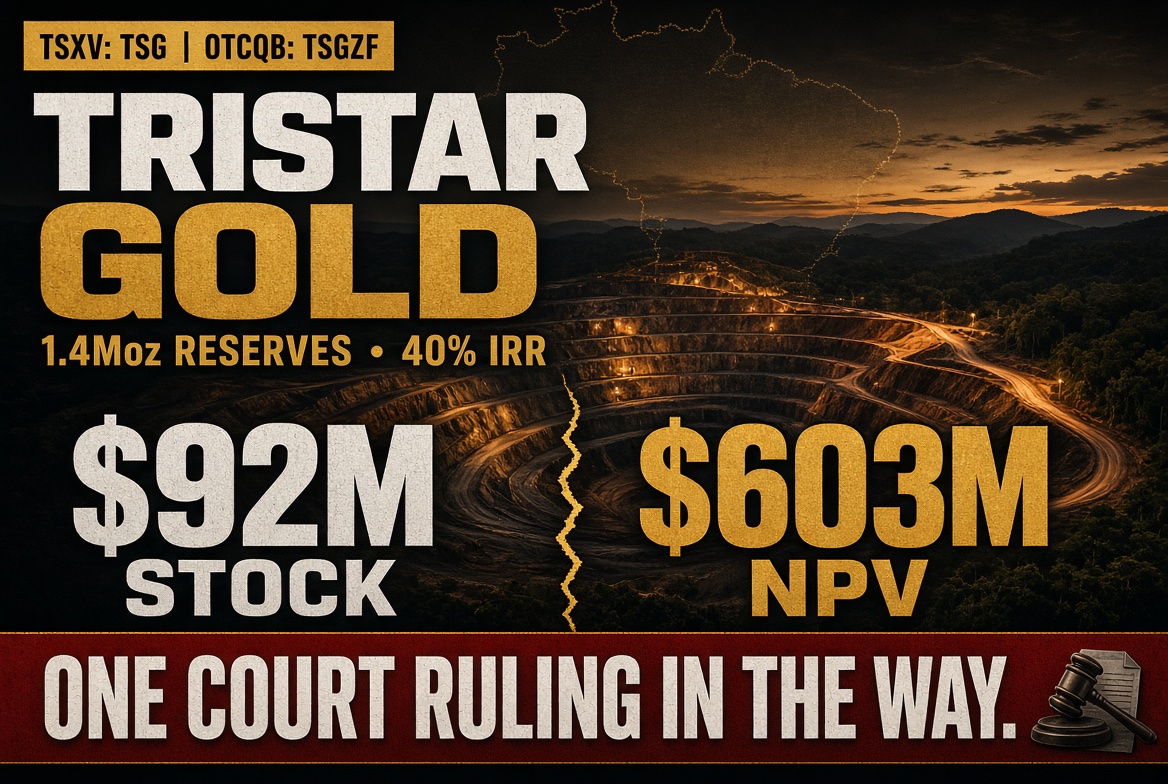
The investment case is simple. Castelo de Sonhos is no longer an early-stage exploration story. The project already has 1.8 Moz of Indicated gold resources plus 0.7 Moz Inferred, including 1.4 Moz of Probable reserves. The 2025 Updated PFS outlines an 11-year open-pit operation producing approximately 121,000 oz gold per year at an AISC of US$1,111/oz. At the PFS base case of US$2,200/oz gold, the project produces a US$603M after-tax NPV5%, a 40% after-tax IRR and a two-year payback period.
The leverage to gold is very strong. At approximately US$3,200/oz gold, TriStar’s updated PFS showed after-tax NPV5% of approximately US$1.353B and IRR of approximately 72%. The August 2026 presentation also shows after-tax NPV10 sensitivity reaching US$1.385B at US$4,000/oz gold.
But investors need to understand why such strong economics have not yet produced a large valuation.
The answer is permitting and legal uncertainty.
TriStar received its Preliminary Licence, or LP, in June 2024. However, Brazil’s Federal Public Prosecutor’s Office, the MPF, subsequently brought a Civil Public Action challenging the environmental licensing process, arguing that potential impacts on the Kayapó communities of the Baú and Menkragnoti Indigenous Territories were not adequately considered and that an Indigenous Component Study and Free, Prior and Informed Consultation should have formed part of the process. TriStar and the State of Pará dispute those claims. As of TriStar’s August 2026 presentation, the LP remains valid, all parties had made submissions, and the company was waiting for the judge to rule.
This makes TriStar a high-quality project with a major binary de-risking catalyst. A favorable legal and permitting resolution could potentially cause a substantial re-rating. An adverse decision, additional consultation requirements, or prolonged litigation could delay development materially.
Projects / Location / MRE / Grades
Project 1: Castelo de Sonhos Gold Project, Pará, Brazil
Flagship Development Asset
Main Asset
Castelo de Sonhos is TriStar’s sole material flagship asset and is 100% owned through its Brazilian subsidiary. The project is located in southwestern Pará State approximately 20 km northeast of the town of Castelo de Sonhos, near the major BR-163 north-south highway.
The project hosts a paleoplacer gold deposit, meaning gold occurs predominantly within ancient quartz-pebble conglomerate horizons. Management compares the geological concept with large paleoplacer systems such as Tarkwa in Ghana and Jacobina in Brazil. The August 2026 presentation identifies approximately 19 km of mineralized conglomerate reef, with the resource remaining open along strike and at depth.
This deposit style is important because the mineralization comes close to surface and supports relatively conventional bulk open-pit mining rather than technically complex underground mining.
Infrastructure
Castelo de Sonhos has above-average infrastructure for a junior development project.
The nearby town lies on BR-163. The project has year-round road access under normal conditions, although heavy seasonal rains can temporarily affect roads and bridges. A 138 kV transmission line runs near BR-163, and the PFS proposes construction of approximately 26 km of transmission infrastructure to connect the project. The site also has an existing exploration camp and local services are available in Castelo de Sonhos.
The proposed processing operation is designed at 10,000 tonnes per day, or approximately 3.6 Mtpa. The processing flowsheet uses crushing, grinding, cyanidation and carbon-in-leach technology. Metallurgical testing supports an estimated 98% gold recovery, which is excellent.
Castelo de Sonhos Mineral Resource Estimate
An important detail: the 2025 PFS updated the project economics, capital costs and operating costs, but it did not produce a new mineral resource estimate.
The current mineral resource remains the October 4, 2021 estimate.
| Area | Category | Tonnes | Grade | Contained Gold |
| Esperança South | Indicated | 29.0 Mt | 1.3 g/t | 1.2 Moz |
| Esperança South | Inferred | 10.0 Mt | 1.2 g/t | 0.4 Moz |
| Esperança East | Indicated | 5.0 Mt | 0.8 g/t | 0.1 Moz |
| Esperança East | Inferred | 12.8 Mt | 0.7 g/t | 0.3 Moz |
| Esperança Center | Indicated | 19.1 Mt | 0.7 g/t | 0.4 Moz |
| Esperança Center | Inferred | 3.3 Mt | 0.9 g/t | 0.1 Moz |
| Total | Indicated | 53.1 Mt | 1.0 g/t | 1.8 Moz |
| Total | Inferred | 26.0 Mt | 0.9 g/t | 0.7 Moz |
The reporting cut-off is 0.26 g/t gold.
Castelo de Sonhos Mineral Reserve Estimate
The reserve estimate also remains based on the 2021 technical work.
| Area | Category | Tonnes | Grade | Contained Gold |
| Esperança South | Probable | 24.2 Mt | 1.28 g/t | 0.99 Moz |
| Esperança East | Probable | 3.1 Mt | 0.82 g/t | 0.08 Moz |
| Esperança Center | Probable | 11.4 Mt | 0.78 g/t | 0.29 Moz |
| Total | Probable | 38.7 Mt | 1.1 g/t | ~1.4 Moz |
There are currently no Proven reserves because there are no Measured resources.
Grade Feel
Castelo de Sonhos is not ultra-high-grade gold, but it has attractive grades for a large conventional open-pit operation.
The overall indicated resource is approximately 1.0 g/t gold and Probable reserves average approximately 1.1 g/t. More importantly, Esperança South-the first mining phase-has a reserve grade around 1.28 g/t and the PFS expects approximately 1.3 g/t plant feed during Phase 1. This gives the project a relatively strong higher-grade starter phase.
2025 Updated PFS Economics
The 2025 Updated PFS uses a base-case gold price of US$2,200/oz and BRL5.75 per US dollar.
| PFS Metric | Value |
| Mine life | 11 years |
| Processing rate | 10,000 tpd / 3.6 Mtpa |
| LOM gold production | 1.33 Moz |
| Average annual gold production | 121,000 oz |
| Phase 1 production | ~146,000 oz/year |
| Phase 1 period | Years 1-6 |
| Average plant grade | 1.1 g/t |
| Phase 1 grade | 1.3 g/t |
| Phase 2 grade | 0.8 g/t |
| Gold recovery | 98% |
| Initial capex | US$296M |
| Contingency | 20% included |
| Cash cost | US$1,080/oz |
| AISC | US$1,111/oz |
| Pre-tax cash flow | US$1.123B |
| After-tax cash flow | US$934M |
| After-tax NPV5% | US$603M |
| After-tax NPV10% | US$393M |
| After-tax IRR | 40% |
| Payback | 2.0 years |
| LOM strip ratio | 9:1 |
Capex Breakdown
| Component | US$ Million |
| Mine | 37.3 |
| Power transmission | 10.8 |
| Processing plant | 187.2 |
| Tailings storage facility | 11.2 |
| 20% contingency | 49.3 |
| Total | 295.8 |
The economics are strong, but the US$296M capex is significant relative to TriStar’s current market capitalization. This is not a low-capex restart story. TriStar will probably require some combination of project debt, equity, strategic investment, royalties/streams, equipment finance, or a larger partner before construction.
Two-Phase Mine Plan
The PFS proposes a useful two-stage mining strategy.
Years 1-6: mining concentrates on higher-grade Esperança South, with feed of approximately 1.3 g/t gold and management showing around 146,000 oz annual production.
Years 7-11: production transitions toward Esperança East and Center, where feed grades decline toward approximately 0.8 g/t gold.
That front-loaded higher-grade production is important because it supports the rapid two-year payback in the PFS.
Exploration / Resource Optionality
The resource is not necessarily the end of Castelo de Sonhos.
TriStar identifies several areas of potential expansion, including strike extensions north and south of Esperança South, down-dip extensions, higher-grade paleochannels, areas between currently scheduled pits and broader mineralized conglomerate horizons. The company estimates approximately 19 km of mineralized conglomerate reef and describes the resource as open along strike and at depth.
The project also already contains 0.7 Moz Inferred gold that is not included as reserve material in the PFS mine plan. This creates a relatively straightforward first layer of optionality before considering completely new discoveries.
Share Structure / Ownership / Insiders
Capital Structure
TriStar’s official stock-information page reported the following at June 9, 2026:
| Capital Structure Metric | Shares |
| Issued and outstanding | 397,541,940 |
| Warrants | 72,307,354 |
| Options | 5,250,000 |
| Fully diluted | 475,099,294 |
The August presentation showed essentially the same figures as of July 30, 2026: approximately 397.5M issued shares, 72.3M warrants, 5.3M options and 475.1M fully diluted shares. There has subsequently been another change.
On August 21, 2026, approximately 6.73M warrants at C$0.20 were exercised, creating approximately C$1.346M of gross proceeds. Based purely on that disclosed subsequent event, issued shares would increase to approximately 404.27M, while the corresponding warrant balance falls. Fully diluted shares remain approximately 475.1M because warrants have simply converted into common shares.
Current Market Capitalization
TSG closed at approximately C$0.195 on September 1, 2026.
Using approximately 404.27M pro-forma issued shares:
Basic market capitalization:
404.27M x C$0.195 ~ C$78.8M
Using 475.10M fully diluted shares:
Fully diluted market capitalization:
475.10M x C$0.195 ~ C$92.6M
That remains extremely small compared with the project’s published PFS economics.
Cash Position
At June 30, 2026, TriStar reported approximately US$9.93M of cash and cash equivalents, versus US$4.45M at December 31, 2025. The balance sheet showed only approximately US$2.15M of total liabilities, much of which consisted of accounting liabilities associated with warrants rather than conventional project debt.
The August 21 warrant exercises subsequently generated another approximately C$1.35M gross cash.
Liquidity therefore looks adequate for near-term corporate, legal, permitting and study work, but nowhere close to the US$296M required to construct the mine.
Recent Dilution
TriStar completed a substantial financing in June 2026.
The company issued 45.011M units at C$0.23, raising gross proceeds of approximately C$10.35M. Each unit included one common share plus one-half warrant exercisable at C$0.30 until June 4, 2028. Agents also received approximately 2.70M compensation warrants.
This financing substantially strengthened the treasury, but it also illustrates one of TriStar’s weaknesses: the share count is already large and future project development could require much more financing.
Share Structure Feel
This is not a tight share structure.
Fully diluted shares around 475M are high for a junior developer. There are also still tens of millions of warrants outstanding.
The positive side is that a substantial number of the warrants are in or close to the money. Further exercises can bring additional cash to TriStar without a completely new financing, although those exercises continue increasing issued shares.
Ownership / Insiders
TriStar’s August 2026 corporate presentation reported:
| Ownership Group | Ownership |
| Institutions | ~46% |
| Insiders | ~5% |
| Retail | ~49% |
The company identifies Auramet Capital Partners, US Global Investors, Konwave and Eric Sprott among its institutional/large investment holders.
External ownership is one of the stronger elements of the story. Available ownership data separately identifies sizable positions held by Auramet, Eric Sprott, US Global Investors and Konwave.
However, for our checklist we should distinguish institutional ownership from insider ownership.
Insiders themselves own only around 5%, third party source that we get insider aligned around 28%. Quite good.
People / Management
| Person | Role | Details | Management Feel |
| Nick Appleyard | President, CEO & Director | More than 25 years of international precious-metals experience across exploration, development and mining. Previously CEO of Chaparral Gold, where he oversaw the sale to an affiliate of Waterton Global Resource Management. Former VP Corporate Development at International Minerals, later sold to Hochschild Mining. | Strong corporate track record and relevant South America project experience. |
| Scott Brunsdon | Chief Financial Officer & Corporate Secretary | Extensive mining-finance experience. Previously CFO of Chaparral Gold and International Minerals, with senior financial experience at Placer Dome North America and more than 28 years in public-company management, corporate development, listings and M&A. | Strong fit for financing, capital markets, reporting and potential transaction work. |
| Fernanda Bretas | Vice President Operations | Geologist with experience in drilling, resource estimation, environmental licensing, Brazilian mining regulation, community relations and camp management. Practical experience in gold and iron exploration in Minas Gerais and Para. | Important Brazil-specific operating and regulatory experience. |
| Andrew Grant | Vice President | Specializes in corporate social responsibility and strategic operations. Experience includes stakeholder engagement, partnerships involving companies, governments and civil society, and work across more than 40 countries. | Highly relevant because Indigenous consultation, stakeholder engagement and legal certainty are key risks. |
| Marcus Brewster | Director | Geologist and mining engineer with direct experience in large-scale paleoplacer gold mines, including Tarkwa and Damang in Ghana. Eventually became General Manager at Damang. | Unusually relevant technical and operating experience for a paleoplacer-style project like Castelo de Sonhos. |
| Mark Isto | Director | Approximately 38 years of mining engineering, mine management and project-development experience. Former EVP and COO of Royal Gold, Senior VP in the projects group at Kinross Gold, and senior operating roles at Placer Dome. | Strong mine-build and operating credibility. |
| Carlos Vilhena | Director | Specialist legal experience with an LLM in Natural Resources Law and a Brazilian law degree from the University of Brasilia. | Important board-level expertise given Brazilian permitting and legal complexity. |
| Rod McKeen | Lead Director | More than 35 years of legal experience acting for Canadian public companies with an international focus. | Useful governance and transaction oversight. |
| Eric Zaunscherb | Director | Geologist with more than 32 years of experience as a mining analyst. Previously Managing Director, Research – Metals & Mining at Canaccord Genuity. | Adds market, technical and institutional-investor perspective. |
Risks / Catalysts / Timeline
Key Risks
| Key Risk | Why It Matters |
| Civil Public Action / Indigenous Consultation Risk | The MPF challenge to the environmental licensing process is the biggest risk. The LP remains valid, but a ruling, additional consultation requirements, or prolonged litigation could materially change the timetable and valuation. |
| Further Permitting Risk | The LP is only the first stage. The Installation Licence and Operating Licence are still required before construction and operation. |
| Financing Risk | Initial capex is approximately US$296M, very large compared with the current market capitalization. Project debt, equity, strategic funding, royalties/streams or partnership capital may be required. |
| Dilution Risk | Fully diluted shares are already around 475M. The June 2026 financing added 45M units plus warrants, and future construction equity could add more dilution. |
| Resource / Reserve Age Risk | The economics were updated in 2025, but the resource and reserve models retain an October 4, 2021 effective date. Future drilling/resource updates may be important. |
| Construction Risk | The project still needs mine development, a 3.6 Mtpa plant, power transmission, tailings storage, roads and supporting infrastructure. Cost escalation could affect returns. |
| Strip Ratio Risk | The PFS shows an approximately 9:1 LOM strip ratio, meaning waste movement, diesel, equipment productivity and sequencing matter. |
| Grade Transition Risk | Years 1-6 benefit from higher-grade Esperança South feed, while later years move toward lower-grade East and Center material. |
| Royalty / Tax Burden | The PFS incorporates approximately 3.5% NSR royalties plus a 1.5% Brazilian federal gross royalty, before corporate tax. |
| Gold Price / Brazilian Real Risk | The PFS assumes US$2,200/oz gold and BRL5.75 per US dollar. A stronger Brazilian real or weaker gold price could pressure economics. |
Catalysts
| Period | Potential Catalyst |
| Near term | Federal judge ruling / greater clarity in the Civil Public Action |
| Near term | Potential negotiated pathway providing greater legal certainty around Indigenous-rights issues |
| 2026 onward | Completion of remaining LP conditions |
| 2026 onward | Studies and technical work required for LI application |
| After legal clarity | Resumption / expansion of drilling programs |
| Medium term | Updated drilling and potential resource growth |
| Medium term | Feasibility-level engineering and optimization |
| Medium term | Installation Licence advancement |
| Medium term | Strategic financing / project debt / development partner |
| Later stage | Construction decision |
| Later stage | Operating Licence |
| Longer term | First gold production |
| Longer term | Expansion of resources beyond the current 1.8 Moz Indicated + 0.7 Moz Inferred base |
TriStar’s August 4, 2026 communication also stated its willingness to seek a solution that respects Indigenous rights while providing greater transparency, good faith and long-term legal certainty. That raises the possibility that the ultimate catalyst may be a negotiated or procedural solution rather than simply a binary court victory.
Expected Timeline to Full Production
| Year / Period | Focus | What It Means |
| 2026 | Legal and permitting de-risking | Immediate priority is the federal legal process around the LP, while TriStar completes LP conditions and advances studies needed for the LI application. |
| 2027-2028 | Potential feasibility / LI advancement | If the LP dispute is resolved or reaches a workable settlement, the next phase could include project optimization, feasibility-level engineering, drilling/resource work and Installation Licence advancement. This is a scenario, not formal guidance. |
| Following LI + Financing | Construction | After permits, engineering and financing, TriStar could make a construction decision and build the mine, plant, power line, tailings facility and related infrastructure. |
| Following Construction | Operating Licence and First Gold | The final major regulatory milestone is the Operating Licence before commercial operation. There is no responsible way to assign a precise first-gold year without a large assumption about the legal timeline. |
Critical path: legal clarity -> LI -> feasibility / financing -> construction -> LO -> production.
Valuation / Updated Valuation Summary
Important Valuation Note
TriStar is one of the more difficult companies to value using only the share price because the market is applying an unusually large legal/permitting discount.
The economics of Castelo de Sonhos are already strong.
At US$2,200 gold:
After-tax NPV5 = US$603M
After-tax NPV10 = US$393M
After-tax cash flow = US$934M
After-tax IRR = 40%
At approximately US$3,200 gold:
After-tax NPV5 = approximately US$1.353B
After-tax IRR = approximately 72%
At US$4,000 gold:
Company sensitivity indicates after-tax NPV10 of approximately US$1.385B
IRR approximately 93.6%
Against a fully diluted market capitalization of only approximately C$92.6M at C$0.195/share, the valuation disconnect is very large.
But the discount is not free money. The market is pricing legal uncertainty, construction financing, remaining permits, dilution and execution risk.
Optionality Value Assumptions
The PFS reserves contain approximately 1.4 Moz.
Outside those reserves, TriStar has approximately 0.7 Moz of Inferred resources, plus additional untested strike and down-dip potential. Since Inferred material is not treated as economic ore in the PFS mine plan, we can assign a separate conservative optionality value to those ounces without treating them as current reserves.
For simplicity:
| Optionality | Conservative | Base | Aggressive |
| 0.7 Moz Inferred @ US$25/oz | US$17.5M | – | – |
| 0.7 Moz Inferred @ US$50/oz | – | US$35.0M | – |
| 0.7 Moz Inferred @ US$75/oz | – | – | US$52.5M |
| Additional untested extensions | No value | No value | No value |
| Total Optionality Value | US$17.5M | US$35.0M | US$52.5M |
For the main valuation model, use US$35M of optionality.
This is deliberately conservative because it gives zero value to completely unclassified exploration potential across the broader ~19 km mineralized reef.
Using 475.1M fully diluted shares and approximately US$1 = C$1.392:
Base optionality ~ C$0.10/share.
Castelo de Sonhos High-Gold-Price FCF Sensitivity Model
TriStar already provides an official PFS cash-flow number, so we can anchor our model to that rather than simply multiplying production by the gold price.
Starting Point
At US$2,200 gold:
LOM after-tax cash flow = US$934M
LOM production = approximately 1.33 Moz
Mine life = 11 years
The PFS also includes approximately 5% gross royalty exposure through the 3.5% NSR plus 1.5% federal royalty. Brazil’s headline corporate tax burden is generally around 34%.
For our simplified high-price calculation:
Incremental after-tax cash flow per US$1/oz increase ~
1.33M oz x 95% after royalties x 66% after assumed tax
~ US$0.834M of additional LOM cash flow per US$1/oz
This is a simplified model only. It ignores tax-loss timing, depreciation, working capital, financing structure, inflation, changing royalties, currency changes and mine-plan optimization.
US$6,000/oz Gold Scenario
Gold-price increase from base case:
US$6,000 – US$2,200 = US$3,800/oz
Estimated incremental after-tax LOM cash flow:
US$3,800 x US$0.834M
~ US$3.169B
Add PFS base-case after-tax cash flow:
US$3.169B + US$934M
~ US$4.103B LOM after-tax cash flow
Average annual FCF proxy:
US$4.103B ÷ 11 years
~ US$373M/year
US$7,000/oz Gold Scenario
Gold-price increase:
US$7,000 – US$2,200 = US$4,800/oz
Estimated incremental after-tax LOM cash flow:
US$4,800 x US$0.834M
~ US$4.003B
Add PFS base-case cash flow:
US$4.003B + US$934M
~ US$4.937B LOM after-tax cash flow
Average annual FCF proxy:
US$4.937B ÷ 11 years
~ US$449M/year
All-Projects Valuation Table
Using the same 10x / 15x / 20x FCF framework and adding US$35M of base exploration optionality:
| Gold Price | Avg Annual FCF Proxy | Multiple | Core Value | Optionality | Total Implied Value | Approx. CAD Value / FD Share |
| US$6,000 | US$373M | 10x | US$3.73B | US$35M | US$3.76B | C$11.03 |
| US$6,000 | US$373M | 15x | US$5.59B | US$35M | US$5.63B | C$16.49 |
| US$6,000 | US$373M | 20x | US$7.46B | US$35M | US$7.49B | C$21.96 |
| US$7,000 | US$449M | 10x | US$4.49B | US$35M | US$4.52B | C$13.25 |
| US$7,000 | US$449M | 15x | US$6.73B | US$35M | US$6.77B | C$19.82 |
| US$7,000 | US$449M | 20x | US$8.98B | US$35M | US$9.01B | C$26.40 |
These numbers deliberately reproduce the high-price FCF-multiple framework. A 10x-20x multiple applied to the average cash flow of a finite 11-year mine becomes extremely aggressive and can significantly overstate realizable equity value.
For TriStar, P/NAV is the better sanity check.
Summary & Quick Scorecard
| Category | Assessment | Overall |
| Company Overview | Stock ticker: TSG / OTCQB: TSGZF • Main metal: Gold • Project phase: Advanced developer / PFS / permitting • Country: Brazil | – |
| 1. Management | Previous successful project/company sale: Yes • Exploration-to-development experience: Yes • Big mining-company experience: Yes • Capital-markets track record: Yes | Strong |
| 2. Projects | Grade: Moderate • MRE >1.5 Moz: Yes • Reserve: 1.4 Moz • Optionality: Yes | Good |
| 3. Cost Structure | AISC US$1,111/oz: Low / attractive • Initial capex US$296M: Moderate-high • Infrastructure: Good | Strong |
| 4. Share Structure Discipline | Fully diluted shares: ~475.1M • FD market cap at C$0.195: ~C$92.6M • Significant warrants / historical dilution | Strong |
| 5. Insider / Ownership | Insiders: ~5% • Institutions: ~46% • Includes Auramet, Sprott, US Global, Konwave, 28% strategic insider aligned. | Strong |
| 6. Location | Country: Brazil • State: Pará • Mining jurisdiction: Tier 2 in our framework • Infrastructure: Good | Good |
RT Rating, Commentary
TriStar Gold is on our watchlist.
We would rate this as 5 out of 5 stars. But not buying it now.
TriStar checks a large number of the boxes we look for in a gold developer.
The project itself is strong. Castelo de Sonhos contains a meaningful resource and reserve base, has surface mineralization suitable for conventional open-pit mining, excellent approximately 98% gold recoveries, good infrastructure, an attractive US$1,111/oz AISC and a higher-grade first six years of production.
The economics are even stronger. At only US$2,200/oz gold, the PFS already shows US$603M after-tax NPV5, 40% IRR, US$934M after-tax life-of-mine cash flow and a two-year payback. At higher gold prices, the leverage becomes enormous.
Management is another major positive. Nick Appleyard has previously participated in successful company exits, Scott Brunsdon brings mining finance and Placer Dome experience, Marcus Brewster has unusually relevant experience running major paleoplacer mines, Mark Isto adds Royal Gold, Kinross and Placer Dome operating experience, and the board also contains Brazilian natural-resources legal and capital-market expertise.
The valuation is clearly cheap compared with the underlying project economics.
But a main primary concern is their legal issue.
The legal and permitting situation, the LP is still valid, but the Federal Civil Public Action involving the MPF, FUNAI and potential Indigenous impacts must be resolved or otherwise brought to a workable conclusion. Until that happens, the market has a valid reason to apply a substantial discount. Even we score these as 5 stars, we personally not buying it until the issue fully resolve.
Join RockeTeller
At RockeTeller, we do not just chase stories. We hunt for rare mining stocks with the right mix of criteria. Every company is tested through our specific checklist before it earns a place on our watchlist.
We ask the hard questions that matter most: Is this a stock we would actually back, what is the realistic target price, and how strong is the risk-reward?
Our watchlist is reserved for high-quality setups with real multibagger potential, not hype. If you want serious deep-dive research with conviction, subscribe to RockeTeller.com.