Borealis Mining Company Ltd. TSXV: BOGO / OTCQB: BORMF / FSE: L4B0
Introduction
Borealis Mining Company Ltd. is an emerging Nevada-focused gold producer and developer built around three assets: the Borealis Mine, the Sandman Gold Project, and the early-stage Big Balds Project. The investment thesis is unusual for a junior because Borealis already owns a permitted, operating heap-leach mine and ADR processing facility while simultaneously advancing a second project with a current NI 43-101 resource and a positive 2026 Preliminary Economic Assessment.
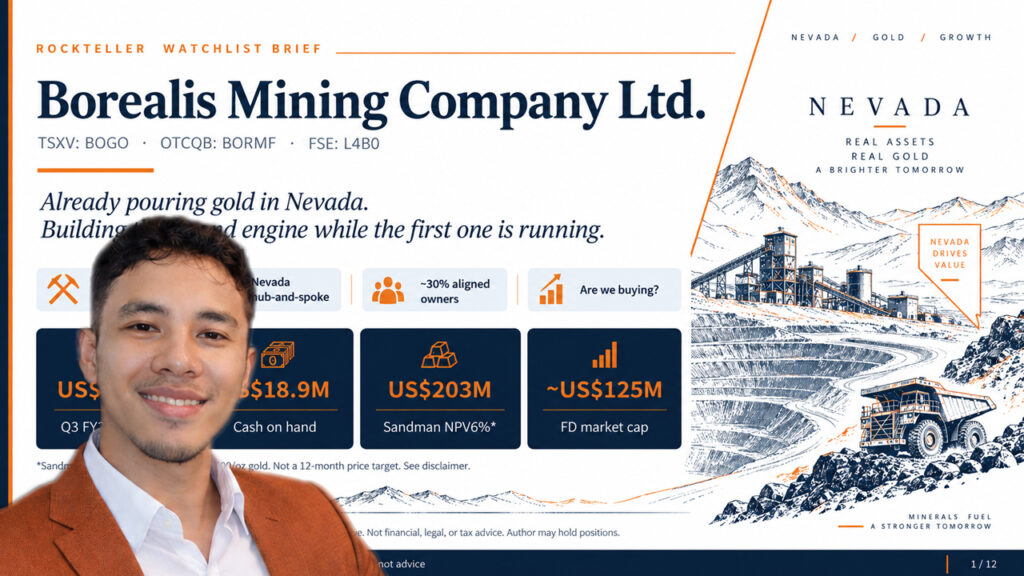
The main story today is the Borealis Mine. The company restarted fresh mining during 2026 and is now mining, crushing, stacking and recovering gold from multiple open pits. For the fiscal quarter ended April 30, 2026, Borealis reported US$6.06 million of revenue and US$1.83 million of gross profit, with cash of US$18.87 million and working capital of US$26.61 million. This is important because Borealis is no longer simply waiting for a future mine-development decision; it is already generating real revenue from Nevada.
But investors need to understand one major distinction. The company’s decision to restart mining at Borealis was not based on a feasibility study demonstrating economic and technical viability from current mineral reserves. The historical resources at Borealis are also not considered current NI 43-101 resources. Therefore, the operating story is real, but the technical confidence behind the long-term mine plan remains much weaker than it would be for a conventional producer with current reserves, a feasibility study and published AISC guidance.
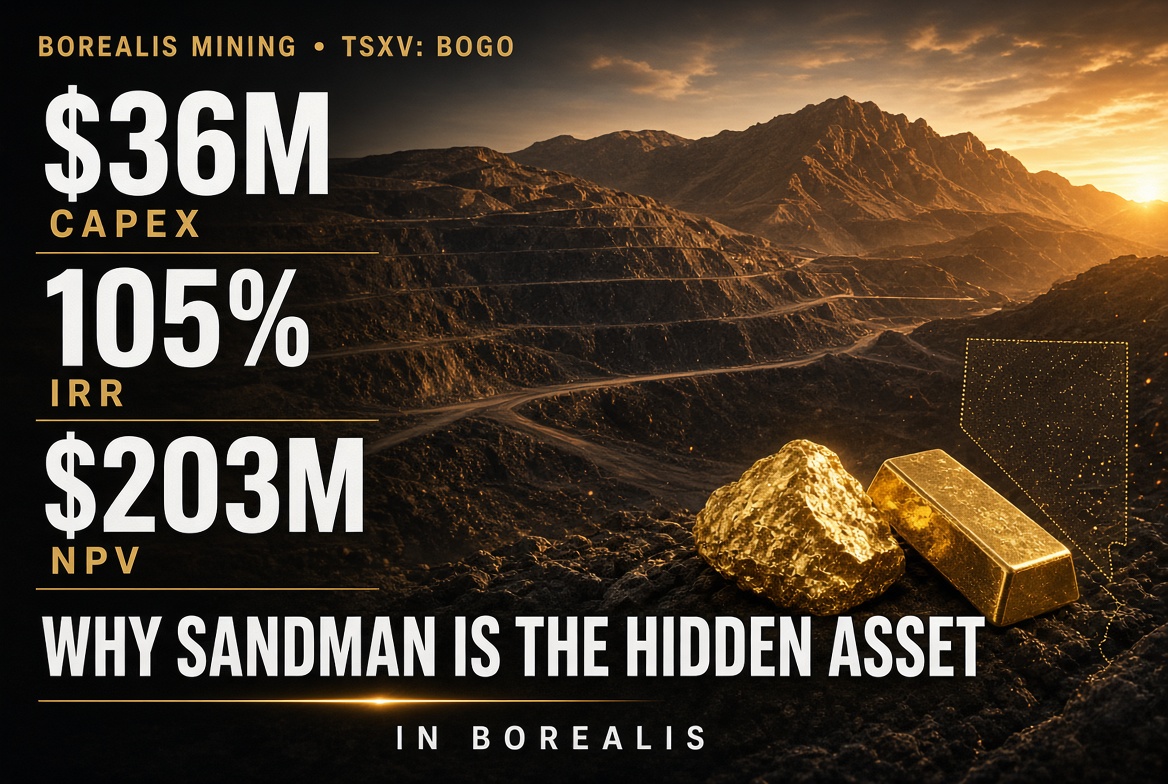
The second important asset is Sandman. Sandman gives Borealis something the main mine currently lacks: a current resource, a defined mine concept and formal project economics. The updated 2026 PEA outlines approximately 38,000 oz of annual gold production for nine years, only about US$36 million of initial capital, an after-tax NPV6% of US$203 million and an after-tax IRR of approximately 105% using US$2,600/oz gold.
This creates an interesting two-engine investment case. Borealis Mine can potentially generate cash flow, expand production and provide infrastructure, while Sandman can become the company’s more clearly defined second mine. Big Balds provides longer-term exploration optionality.
The strongest positives are the Nevada jurisdiction, existing infrastructure, extremely experienced management and board, approximately 30% aligned ownership across insiders, Rob McEwen and Eric Sprott, low Sandman development capex, and the possibility of building a Nevada hub-and-spoke production company.
The biggest risks are the lack of a current resource/reserve-backed economic study at the Borealis Mine, uncertainty around sustainable production costs and recovery rates, Sandman’s PEA-stage technical confidence, future permitting and financing requirements, and the significant dilution already experienced while Borealis built its current asset base.
Projects / Location / MRE / Grades
Project 1: Borealis Gold Mine, Nevada – Flagship Producing / Restart Asset
The Borealis Mine is the company’s flagship operating asset. It is located near Hawthorne in Mineral County, western Nevada, and is 100 percent owned by Borealis Mining. The property comprises approximately 815 unpatented mining claims covering roughly 16,300 acres, together with an existing mine site, open pits, heap-leach pads and a functional adsorption-desorption-recovery, or ADR, facility. Borealis states that the project has historically produced more than 600,000 ounces of gold through open-pit heap-leach mining.
This infrastructure is one of the most valuable parts of the investment thesis. Borealis is not starting with bare ground; it already controls open pits, heap-leach pads, crushing and stacking infrastructure, ADR processing facilities, power and water infrastructure, established site access, mining and processing permits, and an existing operating workforce and contractor base.
The May 2026 corporate presentation estimated infrastructure replacement value at more than US$70 million. This does not mean the infrastructure is automatically worth US$70 million in a valuation, but it shows how expensive it could be for a new developer to recreate what Borealis already controls.
Borealis Production Restart
Borealis began rebuilding production in stages. The company completed its first fresh-stockpile gold pour in September 2025. Fresh open-pit mining subsequently restarted in early 2026, with the first production blast occurring at East Ridge in January 2026. By June 2026, mining, crushing and stacking had expanded across multiple open pits including East Ridge and Deep Ore Flats.
| Operating / Financial Metric | Q3 FY2026 |
| Revenue | US$6.06M |
| Gross profit | US$1.83M |
| Cash | US$18.87M |
| Working capital | US$26.61M |
| Work-in-progress inventory | US$7.39M |
| Gold sold | ~1,265 oz |
| Total material mined | ~726,000 tons |
| Material crushed | ~119,560 tons |
| Material stacked | ~121,102 tons |
The company also added approximately 1,204 recoverable gold ounces to the leach pad during the quarter. This is a very important development because Borealis has crossed the line from a pure development story into an operating company. However, this is still a ramp-up, not yet a mature steady-state operation. Investors need several more quarters of production, recovery, costs and cash-flow data before they can properly judge normalized Borealis Mine economics.
Borealis Historical Mineral Resource
This section requires careful wording. The current 2024 NI 43-101 technical report discusses historical 2011 mineral resource estimates, but SRK explicitly states that these estimates are not current mineral resources, have not been sufficiently verified by the current Qualified Person and have not been depleted for production occurring since March 2011. Borealis is not treating them as current resources.
| Historical Category | Tonnage | Gold Grade | Contained Gold |
| M&I Oxide + Mixed Oxide | 34.419Mt | 0.014 oz/t | 491,200 oz |
| M&I Sulphide | 26.066Mt | 0.051 oz/t | 1,339,700 oz |
| Historical M&I Total | – | – | ~1,830,900 oz |
| Historical Inferred | 18.176Mt | 0.011 oz/t | 195,400 oz |
The historical M&I therefore contains approximately 1.83Moz gold, but this figure must not be treated as a current compliant resource. The oxide and mixed-oxide portion is also very different economically from the sulphide resource. Oxide material can potentially be treated through the existing heap-leach system, while sulphide mineralization would require additional metallurgical work and potentially a fundamentally different processing solution.
For this reason, we do not simply value 1.83Moz by a gold-per-ounce multiple.
Borealis Grade Feel
Borealis is interesting because it contains both lower-grade bulk-tonnage heap-leachable oxide mineralization and zones of significantly higher-grade gold. Recent drilling at Cerro Duro returned:
• 30.5 m grading 4.48 g/t Au
• Including 6.1 m grading 15.16 g/t Au
• 8.1 m grading 1.89 g/t Au
• Several additional wide oxide intervals directly below or adjacent to historical pits
The historical Cerro Duro / Jaime’s Ridge area had approximately 95,600 oz of historical M&I oxide and transition gold grading 0.87 g/t, although that estimate is also non-current. Historical drilling at the deeper sulphide Graben target includes some exceptional intervals, but these remain exploration-stage rather than current resources. The geological upside is clearly there; the next important step is converting historical information and new drilling into a defensible current MRE.
The attraction is not simply the historical ounces. The real attraction is the combination of an existing mine, existing processing infrastructure, operating revenue, a large historical mineralized system and exploration upside. If management can convert the historical data into a current resource, demonstrate sustainable heap-leach recoveries, establish a repeatable mine plan and publish reliable cost guidance, Borealis Mine could receive a significantly higher valuation than it receives today.
Project 2: Sandman Gold Project, Nevada – Flagship Development Asset
Sandman is Borealis Mining’s second major asset and, from a technical-study perspective, arguably the cleaner asset to value. Borealis acquired Sandman through its acquisition of Gold Bull Resources, completed in March 2025 for approximately C$8.9 million. The project is located approximately 12 miles northwest of Winnemucca, Nevada and covers approximately 117 km².
Sandman consists principally of four deposits: Silica Ridge, North Hill, Abel Knoll and Southeast Pediment. It has highway access, nearby power and services, water rights on file and an existing property-wide Exploration Plan of Operations.
One of the most interesting strategic advantages is that Sandman does not necessarily need a completely standalone gold-recovery plant. Loaded carbon generated at Sandman could potentially be transported roughly 220 miles to Borealis Mine’s existing ADR facility for final gold recovery. This allows Borealis to reuse infrastructure it already owns and is one reason Sandman’s initial capital requirement is unusually low.
Sandman Mineral Resource Estimate
| Category | Tonnes | Grade | Gold |
| Indicated Oxide | 12.991Mt | 0.63 g/t | 265,100 oz |
| Indicated Fresh | 5.559Mt | 0.94 g/t | 167,900 oz |
| Total Indicated | 18.550Mt | 0.73 g/t | 433,000 oz |
| Inferred Oxide | 2.377Mt | 0.46 g/t | 35,500 oz |
| Inferred Fresh | 0.869Mt | 0.91 g/t | 25,300 oz |
| Total Inferred | 3.246Mt | 0.58 g/t | 60,800 oz |
Total current indicated + inferred resources contain approximately 493,800 ounces of gold. Approximately 300,600 ounces are oxide gold, which is particularly relevant to the proposed heap-leach development model.
Sandman Grade Feel
Sandman is not a high-grade gold project in the traditional sense. At 0.73 g/t indicated, this is a lower-grade Nevada open-pit heap-leach project. The strength comes from economics rather than headline grade: near-surface mineralization, conventional open-pit mining, low strip ratio, low initial capex, existing regional infrastructure, potential use of Borealis ADR facilities, and strong gold-price leverage.
For Sandman, investors should care more about recovery, strip ratio, tonnes moved, operating cost and capital intensity than about comparing its grade with high-grade underground mines.
Sandman 2026 PEA Economics
The February 2026 PEA is the most important technical document for Sandman. Base-case assumptions use US$2,600/oz gold.
| PEA Metric | Value |
| Mine life | ~9 years |
| Average annual production | ~37,900 oz |
| Total gold production | ~341,000 oz |
| Average mine grade | ~0.73 g/t |
| Recovery | ~75% |
| Strip ratio | ~2.2:1 |
| Initial capex | ~US$36.25M |
| Total LOM capital | ~US$56.95M |
| AISC | ~US$1,823/oz |
| After-tax NPV6% | ~US$203.1M |
| After-tax IRR | ~104.9% |
| Payback | ~1.1 years |
| Average annual post-tax cash flow | ~US$36.3M |
The number that stands out is the initial capital. Approximately US$36 million is extremely low for a project targeting nearly 38,000 ounces of annual production. The AISC is less impressive. At approximately US$1,823/oz, Sandman is not a low-cost project in absolute terms. At US$2,600 gold the economics still work because capital is low and margins are adequate. At substantially higher gold prices, Sandman’s leverage becomes very powerful.
Sandman Gold-Price Sensitivity
| Gold Price | Post-Tax NPV6% | Post-Tax IRR |
| US$1,950 | US$38.7M | 32.2% |
| US$2,600 | US$203.1M | 104.9% |
| US$3,250 | US$367.5M | 168.2% |
| US$3,900 | US$531.8M | 229.3% |
| US$4,550 | US$696.2M | 289.6% |
| US$5,200 | US$860.6M | 349.4% |
This is one of the strongest parts of the Borealis investment case. At US$5,200 gold, Sandman’s post-tax NPV increases to approximately US$861 million, more than four times the base-case NPV, without assuming a larger resource or longer mine life. That gives BOGO very significant gold-price torque.
Project 3: Big Balds Project, Nevada – Early-Stage Exploration Optionality
Big Balds is the least advanced asset in the portfolio but gives Borealis exposure to a completely different Nevada exploration concept. The project is positioned near the structural intersection between the Carlin and Bida trends, less than 10 km west of the Bald Mountain Mine and approximately 120 km south of Elko.
Borealis has identified three priority targets using geophysics and high-arsenic soil geochemistry. Importantly, the principal under-cover targets have never been historically drill tested. Potential deposit styles include Carlin-type sediment-hosted gold, gold-silver-base metal skarn or porphyry mineralization, and intrusive-related gold similar conceptually to the broader Bald Mountain district.
Big Balds has no current MRE and no economic study. Therefore, we assign no material value to Big Balds in the core valuation today. It should be considered free or low-cost exploration optionality until drilling proves otherwise.
Share Structure / Ownership / Insiders
Capital Structure
The latest capital structure shown on Borealis Mining’s investor page reports:
| Capital Structure Metric | Value |
| Common shares | 147,130,615 |
| Warrants | 9,579,071 |
| Broker warrants | 1,019,851 |
| Options / RSUs | 7,158,800 |
| Fully diluted shares | 164,888,337 |
The latest completed TSXV trading session available at the time of this research was September 4, 2026, when BOGO closed at approximately C$1.05. Using C$1.05, the fully diluted market capitalization is approximately C$173.1M. Using the September 4 Bank of Canada CAD/USD rate of roughly 0.7225, this equals approximately US$125M fully diluted market capitalization.
This is still a relatively small valuation considering Borealis already has revenue-producing operations, significant infrastructure and the Sandman PEA.
Share Structure Feel
The current fully diluted share count of approximately 165 million is reasonable for a junior producer/developer. However, investors should not ignore the historical dilution. Borealis had approximately 83.2 million common shares in early 2025 and now has approximately 147.1 million basic shares. Some of this dilution came from value-creating transactions such as the acquisition of Sandman, while additional shares were issued through equity financings.
In January 2026 alone, Borealis completed a C$23.0 million bought-deal financing consisting of 15.341 million shares at C$1.50, together with compensation warrants issued to the underwriters. The positive side is that this capital left Borealis with a stronger balance sheet while funding the Borealis ramp-up and Sandman’s advancement. The negative side is that investors must continue watching value creation per share, not simply company-level growth.
Ownership / Insider Alignment
Borealis has a particularly strong shareholder register for a company of this size. The May 2026 presentation showed approximately:
| Ownership Group | Ownership |
| Insiders | 9% |
| Rob McEwen | 12% |
| Eric Sprott | 9% |
| Institutions | 33% |
| Retail | 36% |
Numbers may not total exactly 100 percent because of rounding. The combination of 9% insiders + 12% Rob McEwen + 9% Eric Sprott equals approximately 30% owner-aligned capital. That is excellent. Institutional ownership of approximately 33 percent provides an additional layer of professional investor support.
People / Management
Management is one of Borealis Mining’s strongest categories.
| Person | Role | Details | Management Feel |
| Bob Buchan | Chairman | Founded Kinross Gold, which grew into one of North America’s largest primary gold producers. After retiring as Kinross CEO in 2005, he was also one of the founders of Katanga Copper. Holds a mining degree and an M.Sc. in Mining Engineering. | Exceptional company-building and mine-sector credibility. |
| Kelly Malcolm | President & CEO / Director | Professional Geologist. Previously VP Exploration at Amex Exploration, where he helped advance multiple gold discoveries and supported more than C$90M of financing. Earlier involved with discovery and delineation of the high-grade 58N deposit at Detour Gold. | Strong exploration and capital-markets background. |
| Greg Gibson | Director | More than 30 years of mining experience. Former CEO of Sprott Mining and Jerritt Canyon Gold. Led Trelawney Mining and Exploration from early-stage explorer to its C$608M acquisition by IAMGOLD in 2012. | Major M&A and mine-building credibility. |
| Christina McCarthy | Director | Geologist with more than 18 years across technical work, capital markets and corporate development. Founded and led Paycore Minerals, acquired by i-80 Gold in 2023; previously worked in corporate development at McEwen Mining, institutional sales and equity research. | Strong capital markets, geology and transaction record. |
| Richard Patricio | Director | Director of NexGen Energy and President and CEO of Mega Uranium. Extensive experience establishing, financing and managing publicly listed mining companies across multiple international markets. | Strong public-market and financing experience. |
| Andreas Steckenborn | Chief Operating Officer | Professional engineer with major mine-development and operating experience. Senior adviser to IAMGOLD on the Côté Gold autonomous mine startup; previously Senior Engineer at Detour Lake from startup through improvement and eventual acquisition by Kirkland Lake Gold. | Very relevant operating and startup experience. |
| Lisanna Lewis | Chief Financial Officer | Approximately 20 years of mining-industry finance experience, much of it in Nevada. Her connection with the Borealis Mine goes back to 2004, through exploration, mine construction and production. | Strong project-specific finance continuity. |
| Iain Campbell | Vice President, Exploration | Previously worked at Detour Lake and advanced to Senior Resource Geologist. Borealis says he was part of the team responsible for a grade-control model that increased Detour mine revenue by more than US$100M over four years. | Strong resource and grade-control background. |
Risks / Catalysts / Timeline
Key Risks
| Key Risk | Why It Matters |
| No current Borealis MRE / Reserve | The flagship operating mine does not currently have a modern NI 43-101 MRE or reserve underpinning its production decision. Historical resources should not be treated as current. |
| Production Decision Risk | Borealis restarted mining without a current feasibility study demonstrating economic and technical viability. Production could ultimately differ materially from management expectations. |
| Operating Ramp-Up Risk | Mining, crushing, stacking and leaching need to operate consistently. One strong quarter does not yet prove sustainable steady-state economics. |
| Recovery / Metallurgy Risk | Heap-leach economics are highly sensitive to recovery rates, crush size, ore characteristics, solution management and leach kinetics. |
| Sulphide Resource Risk | A large portion of the historical Borealis gold endowment is sulphide mineralization and cannot automatically be valued as conventional heap-leach material. |
| Sandman PEA Risk | Sandman remains at PEA level. A PEA can include inferred resources and has materially lower technical confidence than a PFS or feasibility study. |
| Sandman AISC Risk | US$1,823/oz AISC is not particularly low. The project benefits significantly from a strong gold-price environment. |
| Permitting Risk | Borealis is already permitted for current operations, but expanded activities can require permit amendments. Sandman still needs further permitting before construction. |
| Financing Risk | Sandman’s US$36M initial capex is low, but Borealis must also fund exploration, mine ramp-up, working capital and corporate costs. |
| Dilution Risk | Basic shares have increased substantially as the company acquired assets and raised capital. Future equity financing remains possible. |
| Exploration Risk | Borealis, Sandman and Big Balds have meaningful geological upside, but drilling does not guarantee economic resource growth. |
| Gold Price Risk | Sandman is highly leveraged to gold prices. The same leverage works in reverse if gold prices decline materially. |
The most important risk in our opinion is not geology. It is proving sustainable economics at Borealis Mine. The company already knows there is gold. What investors need now is evidence showing how many ounces can be mined consistently, at what recovery, at what cost and for how many years.
Catalysts
| Timeline | Key Milestone |
| 2026 | Continued mining, crushing and stacking ramp-up at Borealis Mine |
| 2026 | Additional Borealis gold production and sales |
| 2026 | More operating data allowing investors to estimate normalized mine margins |
| 2026 | Sandman 5,000 m drilling results |
| 2026 | Metallurgical and geotechnical results from Sandman |
| 2026 | Sandman resource-expansion drilling |
| 2026-2027 | Detailed engineering and mine-planning work at Sandman |
| 2026-2027 | Environmental baseline and permitting advancement |
| Medium term | Potential updated Borealis MRE following further drilling and historical-data validation |
| Medium term | Possible updated Sandman resource / higher-confidence technical study |
| Medium term | Sandman construction decision |
| Longer term | Sandman development and potential production |
| Longer term | Big Balds first meaningful exploration drilling |
| Longer term | Potential Nevada hub-and-spoke production model using Borealis infrastructure |
In June 2026, Borealis started a 5,000 metre Sandman drill program. Approximately 1,660 metres were designated for metallurgical and geotechnical drilling across the four deposits, with the remaining drilling targeting resource expansion and new exploration targets. Sandman is simultaneously undergoing detailed engineering, metallurgy and permitting work aimed at moving the project toward a future construction decision.
Expected Timeline to Full Production
| Period | Focus | What It Means |
| 2026 | Borealis operating ramp-up | Borealis Mine is already producing and selling gold. The question is when it can demonstrate stable, repeatable and profitable production. |
| 2026 | Operating consistency | Focus is mining across multiple pits, crushing, stacking, leaching, ADR recovery and increasing recoverable gold placed on leach pads. |
| 2026-2027 | Borealis de-risking + Sandman engineering | Investors should get increasingly useful operating data from Borealis while Sandman progresses engineering, metallurgy, geotechnical work, environmental baseline studies and permitting. |
| Medium term | Current Borealis MRE | A current Borealis MRE would be an especially important de-risking event because it could finally connect the operating mine with a modern resource model. |
| 2027 and beyond | Sandman development decision | Borealis has not published a firm first-production date for Sandman. Timing will depend on permitting, engineering, metallurgy, financing and future technical studies. |
| Longer term | Nevada hub-and-spoke producer | If Sandman is successfully developed, Borealis could evolve from a single-mine restart story into a multi-asset Nevada producer. |
Valuation
Important Valuation Note
Borealis Mining requires a different valuation method from the 1911 Gold example in the Gold template. The Borealis Mine does not currently have a compliant mine-plan-level economic study or current MRE that we can responsibly model. Sandman does.
| Asset | Valuation Treatment |
| Sandman | Primary PEA-backed NPV valuation |
| Borealis Mine | Unmodeled operating / resource / infrastructure upside |
| Big Balds | Unmodeled exploration optionality |
| Future Borealis MRE | Not included until published |
| Future Sandman resource growth | Not included |
This approach is deliberately conservative. We are not assigning speculative dollar values to Borealis Mine’s historical 1.83Moz M&I estimate. If Borealis eventually publishes a current MRE and a reliable mine plan, that asset can be added properly to the valuation.
Sandman High-Gold-Price NPV Sensitivity Model
The company provides NPV sensitivity only up to US$5,200/oz gold. At US$4,550, NPV6% is US$696.19M. At US$5,200, NPV6% is US$860.55M. The difference is US$164.36M over a US$650/oz gold-price change, or approximately US$0.253M of NPV per US$1/oz gold.
This allows us to create a simplified high-gold-price torque model. Important: this is our own linear extrapolation outside the company’s disclosed sensitivity range. It is not an official Borealis forecast.
| Gold Price | Sandman Estimated NPV | NPV Multiple | Implied Equity / Project Value | Implied Value / FD Share |
| US$6,000 | US$1.063B | 0.30x | ~US$319M | ~C$2.67/share |
| US$6,000 | US$1.063B | 0.50x | ~US$531M | ~C$4.45/share |
| US$6,000 | US$1.063B | 0.75x | ~US$797M | ~C$6.68/share |
| US$7,000 | US$1.316B | 0.30x | ~US$395M | ~C$3.31/share |
| US$7,000 | US$1.316B | 0.50x | ~US$658M | ~C$5.51/share |
| US$7,000 | US$1.316B | 0.75x | ~US$987M | ~C$8.26/share |
These values should not be read as conventional 12-month price targets. They represent long-term high-gold-price project valuation sensitivity under the assumption that Sandman’s 2026 PEA concept is successfully advanced.
The most interesting observation is that Borealis Mine is not required to make the valuation interesting. At a current BOGO price around C$1.05, Sandman alone could create substantial valuation leverage if gold remains structurally high and the project continues to de-risk. The Borealis Mine then becomes an operating asset layered on top. That is the main attraction.
Summary & Quick Scorecard
| Category | Points / Observation | Overall |
| Company Overview | Stock ticker: BOGO / BORMF / L4B0 Main metal: Gold Phase: Producer/restart + developer Country: United States State: Nevada | – |
| 1. Management | Previous successful project / company sale: Yes Exploration-to-development experience: Yes Major mining-company experience: Yes Capital-markets track record: Yes | Strong |
| 2. Projects | High grades: Yes locally at Borealis, but Sandman is lower-grade bulk heap leach Current large MRE: Sandman is current; Borealis ~1.83Moz figure is historical/non-current Optionality: Yes | Strong |
| 3. Cost Structure | Low AISC: No, Sandman ~US$1,823/oz Low capex / existing infrastructure: Yes, Sandman ~US$36M initial capex + existing Borealis ADR | Good |
| 4. Share Structure Discipline | Fully diluted shares: ~164.9M FD market cap at C$1.05: ~C$173M / ~US$125M | Strong |
| 5. Insider / Ownership | Insiders: ~9% Rob McEwen: ~12% Eric Sprott: ~9% Institutions: ~33% Insider + McEwen + Sprott aligned: ~30% | Strong |
| 6. Location | Country: United States State: Nevada Mining jurisdiction: Tier 1 Borealis: Walker Lane Sandman: Humboldt County / Winnemucca | Strong |
RT Rating, Commentary
Borealis Mining Company Ltd. is on our watchlist.
We would currently rate Borealis Mining 5 out of 5 stars.
Borealis ticks many of the boxes we look for: one of the strongest management teams among smaller Nevada gold companies, excellent shareholder alignment, existing mining and processing infrastructure, active gold sales, a low-capex second development asset, strong exposure to higher gold prices, and district-scale exploration optionality.
The management team is particularly impressive. Bob Buchan founded Kinross. Greg Gibson led Trelawney through a C$608 million sale. Christina McCarthy founded Paycore before its acquisition by i-80 Gold. Andreas Steckenborn has Detour and Côté operational experience. Kelly Malcolm brings exploration and capital-markets experience. This is a much stronger team than we normally see behind a company with only approximately C$170M of fully diluted market capitalization.
The ownership structure is another major positive. Approximately 30 percent is aligned between insiders, Rob McEwen and Eric Sprott, with roughly another one-third held by institutions based on the May 2026 presentation. That gives Borealis both serious shareholder backing and access to mining capital.
The Borealis Mine itself is attractive because the infrastructure already exists. The company does not need to build an entire mine from zero. It already has open pits, heap-leach pads, ADR processing, utilities, permits and an operating workforce. Revenue of US$6.1M during the April 2026 quarter shows that these assets are actually being used, rather than sitting idle.
Sandman could be the hidden value driver. The PEA gives Borealis a second project capable of around 38,000 oz per year with only approximately US$36M of initial capex. At US$2,600 gold, the project already generates US$203M NPV6%. At US$5,200 gold, the company sensitivity reaches approximately US$861M. That is enormous leverage relative to Borealis Mining’s present valuation.
But there are a few important reasons we need to be careful. The first is the Borealis Mine resource situation. The widely discussed historical ~1.8Moz M&I gold figure is not a current NI 43-101 resource. The current technical report explicitly warns investors not to rely on it as a current resource. Even more importantly, Borealis’ current production decision is not based on a feasibility study of mineral reserves.
That creates substantially more uncertainty around long-term mine life, production rates, recovery, costs and profitability than we would accept from a mature producer. Second, Sandman’s AISC of approximately US$1,823/oz is not especially low. Third, dilution needs monitoring. Some of the dilution was clearly value-creating, but the share count has increased considerably. The next stage needs to demonstrate that value per share grows faster than the share count.
The key thing we want to see now is execution. If Borealis can demonstrate several quarters of stable mine production, establish predictable operating costs and recoveries, publish a current Borealis resource, continue expanding Sandman and move Sandman toward a higher-confidence development study, our conviction would increase significantly.
However, since this team has such a strong proven track record, we may have to close one eye on a few things. We’re buying.
Join RockeTeller
At RockeTeller, we do not just chase stories. We hunt for rare mining stocks with the right mix of criteria. Every company is tested through our specific checklist before it earns a place on our watchlist. We ask the hard questions that matter most: Is this a stock we would actually back, what is the realistic target price, and how strong is the risk-reward?
Our watchlist is reserved for high-quality setups with real multibagger potential, not hype. If you want serious deep-dive research with conviction, subscribe to RockeTeller.com.