Bravo Mining Corp. TSXV: BRVO / OTCQX: BRVMF
Introduction
Bravo Mining Corp. is a Canadian- and Brazil-based mineral exploration and development company focused on advancing its 100%-owned Luanga PGM+Au+Ni Project in Para State, Brazil. Luanga contains palladium, platinum, rhodium, gold and sulphide nickel, together with additional copper-gold and magmatic nickel-copper-PGM exploration potential.
Luanga is located in the Carajas Mineral Province, one of the world’s most important mining districts. The project is approximately 45 km north-northeast of Parauapebas and benefits from paved and unpaved road access, nearby hydroelectric grid power, regional rail and port infrastructure, commercial airports, mining contractors and an experienced local mining workforce.
The investment case is based on five main pillars: a large, shallow and high-confidence polymetallic resource; a 2025 PEA showing strong economics and a potential 17-year open-pit operation; exposure to palladium, platinum, rhodium, nickel and gold; experienced management with a successful Brazil mine-build and corporate-sale record; and further upside from resource expansion, improved metallurgy, vertical integration, oxide processing, IOCG-style copper-gold targets and magmatic nickel-copper-PGM discoveries.
Bravo’s 2025 Mineral Resource Estimate contains 158 Mt grading 2.04 g/t PdEq for 10.4 Moz PdEq in Measured and Indicated resources, plus 78 Mt grading 2.01 g/t PdEq for 5.0 Moz PdEq in Inferred resources. Around 67% of the total resource is already classified as Measured and Indicated.
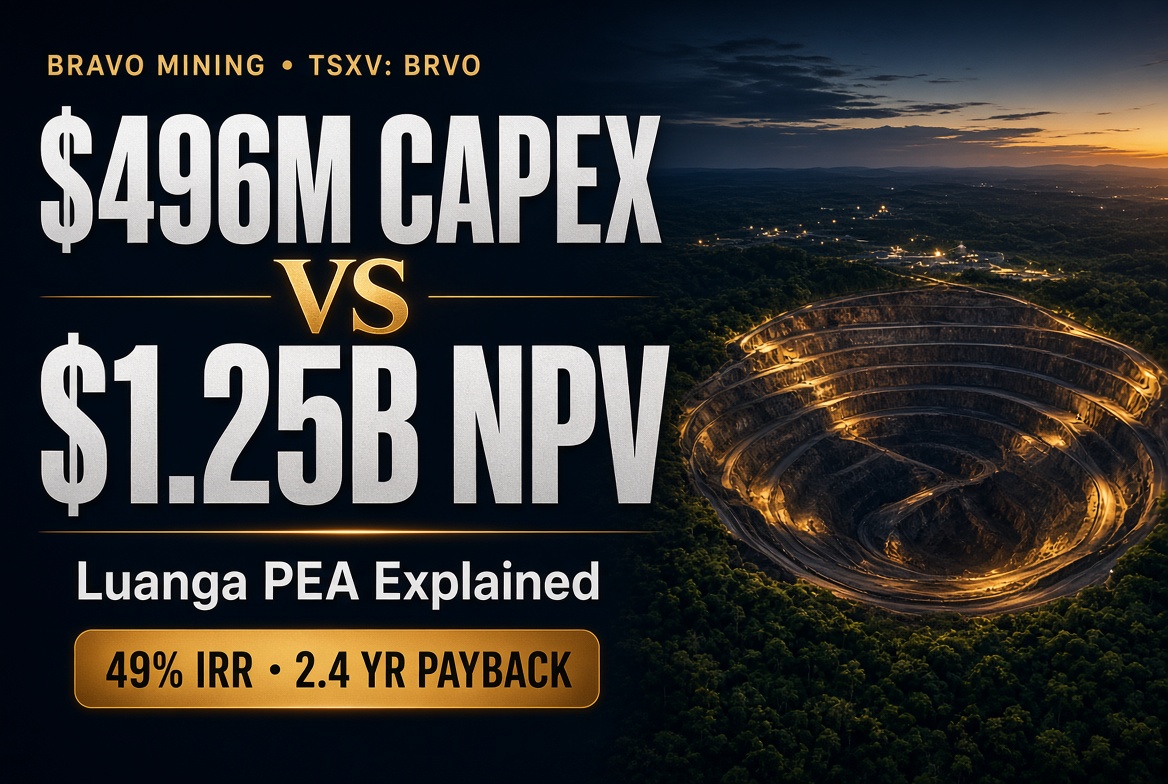
The 2025 PEA outlined after-tax NPV8% of US$1.249B for the concentrate-sales base case and US$1.861B for the vertically integrated alternate case. Both scenarios produced an after-tax IRR of around 49% and a post-construction payback period of 2.4 years.
The main strength is scale combined with relatively low projected operating costs. The main challenge is that Luanga remains a pre-production project. Bravo must complete the PFS and DFS, convert resources into reserves, finalize metallurgy and processing, secure permits and project financing, establish an acceptable concentrate sales or downstream-processing strategy, and build the mine.
Projects / Location / MRE / Grades
Project 1: Luanga PGM+Au+Ni Project, Para, Brazil – Flagship Advanced Development Asset
Luanga is Bravo Mining’s flagship and only material mineral property. It covers a 7,810-hectare exploration licence in the Carajas Mineral Province of Para State, Brazil. Bravo holds a 100% interest through its Brazilian subsidiary.
| Item | Details |
| Ownership | 100% through Brazilian subsidiary |
| Location | Carajas Mineral Province, Para State, Brazil, around 45 km from Parauapebas |
| Deposit style | Large shallow PGM+Au+Ni polymetallic system hosted in a mafic-ultramafic complex |
| Mineralized footprint | Near-surface expression around 7 km by 3.5 km; mineralized zones generally 10-50 m thick |
| Surface advantage | Around 86% of total MRE tonnage is within 250 m of surface |
| Infrastructure | Nearby roads, 138 kV hydroelectric line within about 20 km, rail/port access, water, airports, contractors and mining workforce |
| Royalties | 1% NSR to Vale; 2% royalty on net operating revenue from platinum-concentrate production payable to BNDES; possible future royalty terms for other products |
Luanga Mineral Resource Estimate
The current MRE has an effective date of February 18, 2025 and uses a 0.50 g/t PdEq cut-off grade.
| Resource Category | Tonnes | PdEq Grade | Contained PdEq |
| Measured | 36 Mt | 2.00 g/t | 2.34 Moz |
| Indicated | 122 Mt | 2.06 g/t | 8.06 Moz |
| Measured + Indicated | 158 Mt | 2.04 g/t | 10.40 Moz |
| Inferred | 78 Mt | 2.01 g/t | 5.01 Moz |
| Total M&I + Inferred | 236 Mt | ~2.03 g/t | ~15.41 Moz |
| Resource Category | Palladium | Platinum | Rhodium | Gold | Sulphide Nickel |
| Measured + Indicated | 5.00 Moz | 3.14 Moz | 451 koz | 262 koz | 194,848 t |
| Inferred | 2.42 Moz | 1.48 Moz | 202 koz | 128 koz | 97,719 t |
| Total | 7.42 Moz | 4.61 Moz | 653 koz | 390 koz | 292,567 t |
| Metal | Estimated Contribution to PdEq Value |
| Palladium | 47% |
| Platinum | 25% |
| Rhodium | 13% |
| Sulphide nickel | 13% |
| Gold | 2% |
This matters for valuation. Bravo is not primarily a gold stock. Gold provides useful optionality, but the economic value is dominated by palladium, platinum, rhodium and nickel. The 2025 MRE also improved materially from 2023, with M&I tonnes increasing 117%, grade improving 17%, and contained M&I PdEq ounces increasing 154%.
Luanga Grade Feel
Luanga is not a high-grade gold deposit. Standalone gold grade is only around 0.05 g/t in the combined M&I resource, which would be unattractive if gold were the only payable metal. The deposit should instead be judged as a polymetallic bulk-tonnage PGM project.
On that basis, the 2.04 g/t PdEq M&I grade is strong for a large, shallow, open-pit PGM project, especially when combined with scale and multi-metal revenue. Localized higher-grade drilling, including 51 m at 3.7 g/t PGM+Au and 0.33% nickel, 6 m at 6.81 g/t PGM+Au, and 13.44 m at 2.02 g/t PGM+Au with 1.55% sulphide nickel and 0.33% copper, adds further upside.
Luanga PEA Economics
The July 2025 PEA evaluated two development options: a concentrate-sales base case and a vertically integrated alternate case involving additional downstream processing in Brazil.
| PEA Metric | Concentrate-Sales Base Case | Vertically Integrated Case |
| Mine life | 17 years | 17 years |
| Peak processing capacity | 10.1 Mtpa | 10.1 Mtpa |
| Initial CAPEX | US$496.0M | US$677.6M |
| Sustaining CAPEX | US$97.1M | US$97.1M |
| Closure cost | US$17.9M | US$17.9M |
| LOM total capital | US$611.0M | US$792.6M |
| Average annual net revenue | US$643.7M | US$788.7M |
| Average annual free cash flow | US$143.1M | US$216.8M |
| After-tax NPV8% | US$1.249B | US$1.861B |
| After-tax IRR | 49.7% | 49.6% |
| Payback | 2.4 years | 2.4 years |
| AISC | US$638/oz PdEq | US$697/oz PdEq |
| CAPEX-to-NPV ratio | 0.40x | 0.36x |
| Metal | Average Annual Payable Production |
| Palladium | 255,000 oz |
| Platinum | 158,000 oz |
| Rhodium | 15,000 oz |
| Gold | 8,500 oz |
| Nickel | 8,549 tonnes |
| Commodity | PEA Price Assumption | PEA Fresh-Rock Recovery |
| Palladium | US$1,271/oz | 77% |
| Platinum | US$1,500/oz | 81% |
| Rhodium | US$6,000/oz | 52% |
| Gold | US$3,251/oz | 50% |
| Nickel | US$8.00/lb | 62% |
The PEA assumes plant ramp-up from around 5 Mtpa to 10 Mtpa within 24 months of commissioning. Around 67% of preliminary production material comes from M&I resources, while around 33% comes from Inferred resources. That Inferred material must be upgraded before it can be included in a PFS mine plan.
Bravo’s 2026 Jameson Cell testing showed apparent recovery and concentrate-grade improvements versus the conventional flotation baseline. These results are promising, but their economic benefit must still be confirmed through the PFS, further locked-cycle work, pilot-scale testing, engineering design and eventual commercial operation.
Project 2: Luanga Copper-Gold Exploration – IOCG-Style Optionality
Bravo has created a dedicated Copper-Gold Exploration Division to evaluate IOCG-style targets within and around Luanga. This became more credible after high-grade copper-gold intercepts at Target T5, including 11.48 m grading 14.3% copper and 3.3 g/t gold, including 2.9 m grading 22.9% copper and 3.6 g/t gold, plus 8.75 m grading 9.48% copper and 2.1 g/t gold.
These grades are highly encouraging, but T5 and the broader copper-gold target portfolio do not yet have a mineral resource. Investors should treat this division as speculative exploration optionality until drilling defines continuity, size and economics.
The 2026 Phase 1 program includes mapping, expanded soil and rock sampling, around 50 line-km of deep IP surveying, additional electromagnetic work and an initial 8,000 m of copper-gold drilling. Fabio Masotti, a former Vale Director of Exploration and member of the discovery teams associated with Onto and Sossego/Sequeirinho, was appointed to lead the division.
Project 3: Magmatic Nickel-Copper-PGM Exploration – Babylon and Regional Upside
Bravo is also testing deeper magmatic sulphide targets below and adjacent to the known Luanga resource. Recent drilling intersected massive to semi-massive sulphides containing pentlandite, chalcopyrite and PGM mineralization.
Hole DDH26LU347 returned 13.44 m grading 1.55% sulphide nickel, 0.33% copper and 2.02 g/t PGM+Au, including 6.72 m grading 2.25% sulphide nickel, 0.55% copper and 3.14 g/t PGM+Au. A meaningful magmatic sulphide discovery could have higher grades and materially different economics, but this remains early stage and should not receive hard valuation yet.
Share Structure / Ownership / Insiders
Capital Structure
| Capital Structure / Market Metric | Value |
| Shares issued and outstanding | 137,054,988 as of May 5, 2026; 137,056,988 at June 30, 2026 |
| Options | 7,248,466 |
| Fully diluted shares | 144,303,454 |
| Weighted average option exercise price | C$2.62 |
| Cash and cash equivalents | US$94.07M at June 30, 2026 |
| Total liabilities | US$2.08M |
| Approx. net cash after total liabilities | ~US$91.99M |
| Reference share price | ~C$3.17 on September 10, 2026 |
| Basic market capitalization | ~C$434.5M |
| Fully diluted market capitalization | ~C$457.4M / ~US$331M |
| Approx. enterprise value after net cash | ~US$239M |
| EV / base-case PEA NPV8% | ~0.19x |
Ownership / Insiders
| Ownership / Strategic Holder | Details |
| Board and management | Approximately 45% ownership reported by Bravo |
| Orion Mine Finance | Acquired 7.01M shares in April 2026, around 5.1% of current basic shares |
| Orion financing arrangement | Indicative, non-binding proposal up to US$300M through equity, debt or other instruments, subject to milestones and terms |
| Ownership feel | Very strong insider alignment, with the main decision-makers exposed to the outcome of Luanga |
The Orion arrangement is strategically important, but investors should not treat the potential US$300M as committed project funding. It remains indicative and non-binding, and Bravo still needs to negotiate acceptable financing terms.
People / Management
| Person | Role | Details / Management Feel |
| Luis Azevedo | Executive Chairman & CEO | More than 35 years of mining experience across geology, legal, permitting and corporate development. Previously worked with Western Mining and Barrick; co-founded Avanco Resources, which developed and operated a Carajas copper mine before being acquired by OZ Minerals for around A$430M. Very strong Brazil/Carajas credibility. |
| Simon Mottram | President | More than 32 years across copper, nickel, gold and PGMs. Held executive and senior technical roles with Avanco, Odin Metals, Asian Mineral Resources, Jubilee Mines and Sons of Gwalia. Has progressed discoveries through development and production and lived in Brazil for more than 15 years. |
| Manoel Carlos Cerqueira | CFO | More than 35 years of senior financial-management experience in Brazil, mainly mining. Previously Brazil CFO for Avanco and held senior finance roles with Kinross, Eldorado, Western Mining, BP Mining and Talon. |
| Paulo Ilidio de Brito | VP Exploration | More than 37 years of mining and exploration experience across gold, copper, nickel, iron ore, vanadium, diamonds and fertilizer minerals. NI 43-101 and JORC qualified. |
| Heinrich Muller | VP Technical Services | More than 18 years across exploration, feasibility studies, open-pit commissioning, production management, project development and mineral processing. Previously Anglo Platinum Brazil and Pedra Branca Minerals. |
| Alex Penha | EVP Corporate Development | More than 20 years in junior-mining capital markets, including investment banking, equity research, IPOs, financings, corporate development and M&A. |
| Fabio Masotti | Head of Copper-Gold Exploration | Former Vale Director of Exploration with more than 30 years of exploration experience. Involved in discovery teams for Sossego/Sequeirinho and Onto copper-gold discoveries. |
Risks / Catalysts / Timeline
Key Risks
| Key Risk | Why It Matters |
| PEA-level study risk | Current economics are based on a PEA, which carries wider uncertainty than a PFS or DFS. CAPEX and OPEX may change materially as engineering advances. |
| Inferred-resource risk | Around 33% of PEA production material is Inferred and must be upgraded before inclusion in a PFS mine plan. |
| Metallurgical risk | Luanga has five payable metals with different recoveries. Commercial performance must be proven across the deposit and at larger test scales. |
| Concentrate-market / offtake risk | The global PGM-nickel concentrate market has fewer participants than the gold dore market. Bravo has not yet signed a binding offtake agreement. |
| Payability risk | Smelter payabilities, treatment charges, penalties, transportation costs and concentrate specifications could differ from PEA assumptions. |
| Vertical-integration risk | The integrated case offers higher NPV but requires more capital, processing technology, permitting and operational complexity. |
| CAPEX and financing risk | Initial CAPEX is US$496M-678M. Bravo has strong cash but still cannot build Luanga without additional financing. |
| Dilution risk | Project financing could include equity, causing dilution even if debt, government-backed financing and offtake support are available. |
| Commodity-basket risk | Economics depend primarily on palladium, platinum, rhodium and nickel. Weakness in one or several metals would reduce project value. |
| Automotive-demand / substitution risk | Palladium and rhodium demand is tied to combustion/hybrid vehicle catalysts, while platinum substitution can change demand dynamics. |
| Permitting risk | Bravo has secured the Preliminary Licence, but the Installation Licence and other approvals are still required. |
| Tax-incentive risk | The PEA assumes SUDAM tax benefits, but eligibility was not confirmed when the PEA was completed. |
| High strip-ratio risk | The PEA estimates a 3.7x strip ratio in Years 1-5 and about 7x over the full mine life, requiring large-scale waste movement. |
| Construction risk | Luanga requires a large mine, process plant, tailings/dry-stack facilities, power connections and logistics infrastructure. |
| Exploration risk | IOCG and magmatic sulphide targets are promising but remain speculative until resources are defined. |
Catalysts
| Expected Period | Potential Catalyst |
| Q3 2026 | Completion and publication of the Luanga PFS |
| Q3 2026 | Completion of the main 2026 PGM infill and expansion drilling program |
| After PFS | Submission of the Installation Licence application |
| Late 2026 | Continuing Jameson Cell metallurgical results and process-flow-sheet optimization |
| Late 2026 | Initial drilling of priority copper-gold IOCG targets |
| Late 2026 | Follow-up drilling at Babylon and other magmatic nickel-copper-PGM targets |
| Q1 2027 | Updated Luanga Mineral Resource Estimate |
| 2027 | Resource conversion and reserve-definition work |
| 2027 | Further metallurgical, geotechnical, hydrological, environmental and engineering work |
| Q3 2027 | Targeted completion of the Luanga DFS |
| 2027-2028 | Installation Licence and other permitting progress |
| 2027-2028 | Potential project-financing discussions with Orion, BNDES, FINEP, strategic investors, lenders and offtake partners |
| Medium term | Offtake, toll-treatment, smelting or downstream-processing partnership |
| Medium term | Evaluation of the Barcarena Export Processing Zone for downstream processing |
| Longer term | Construction decision and transition into mine development |
Expected Timeline to Full Production
| Year / Period | Focus | What It Means |
| 2026 | PFS and resource-conversion year | Complete PFS engineering, metallurgy, infill drilling, expansion drilling and initial copper-gold exploration. |
| 2027 | DFS and permitting year | Updated MRE targeted for Q1 2027 and DFS targeted for Q3 2027. Installation Licence work should also advance. |
| 2027-2028 | Financing and approval period | Arrange debt, equity, strategic investment, government-supported financing and offtake or processing agreements. |
| 2028-2029 | Possible construction period | If permits and financing are completed on schedule, major mine and processing-plant construction could begin. |
| 2029-2030 | Possible commissioning | Luanga could potentially begin commissioning, but this remains an analytical estimate rather than company guidance. |
| First 24 months after commissioning | Ramp-up | PEA assumes processing capacity increases from roughly 5 Mtpa to 10 Mtpa within 24 months. |
| Steady state | Large-scale production | The market would judge Bravo on throughput, recoveries, concentrate quality, payabilities, costs and free cash flow. |
Valuation
Important Valuation Note
Bravo should not be valued using a gold-only model. Gold represents only around 2% of the current MRE’s estimated PdEq value contribution. The primary valuation should use Luanga’s PEA NPV because the main drivers are palladium, platinum, rhodium and nickel.
| Valuation Input | Assumption |
| Fully diluted shares | 144.30M |
| Net cash | ~US$91.99M |
| USD/CAD exchange rate | 1.3805 |
| Current reference price | C$3.17 |
| Base-case project NPV8% | US$1.249B |
| Vertically integrated NPV8% | US$1.861B |
| Optionality Asset | Valuation Treatment |
| Luanga sulphide resource | Included in the PEA and P/NAV valuation |
| Vertical integration | Valued as an alternate scenario, not added to the base case |
| Oxide resource / low-grade stockpile | No separate value assigned |
| Resource expansion below the current pit | No separate value assigned until updated resources/studies |
| Copper-gold IOCG targets | No separate value until a resource is defined |
| Magmatic nickel-copper-PGM targets | No separate value until continuity and scale are demonstrated |
| Barcarena downstream facility | Reflected only through the alternate PEA case |
| Potential BNDES/FINEP financing | No value assigned until binding terms exist |
P/NAV Valuation – Concentrate-Sales Base Case
| Scenario | P/NAV Multiple | Project Value | Equity Value incl. Net Cash | US$/Share | C$/Share |
| Conservative | 0.25x | US$312.3M | US$404.2M | US$2.80 | C$3.87 |
| Base | 0.40x | US$499.6M | US$591.6M | US$4.10 | C$5.66 |
| Aggressive | 0.60x | US$749.4M | US$841.4M | US$5.83 | C$8.05 |
| Scenario | Implied Value | Approx. Upside vs C$3.17 |
| Conservative | C$3.87 | 22% |
| Base | C$5.66 | 79% |
| Aggressive | C$8.05 | 154% |
P/NAV Valuation – Vertically Integrated Case
| Scenario | P/NAV Multiple | Project Value | Equity Value incl. Net Cash | US$/Share | C$/Share |
| Conservative | 0.25x | US$465.3M | US$557.2M | US$3.86 | C$5.33 |
| Base | 0.40x | US$744.4M | US$836.4M | US$5.80 | C$8.00 |
| Aggressive | 0.60x | US$1.117B | US$1.209B | US$8.38 | C$11.56 |
The vertically integrated case has higher theoretical value but carries greater capital, technology, permitting, construction and execution risk. It should not receive the same market multiple as a fully financed and permitted project until those risks are materially reduced.
Gold-Price Sensitivity Model
The Gold template normally uses US$6,000/oz and US$7,000/oz gold scenarios. For Bravo, these scenarios have limited influence because gold is a secondary revenue source. The following mechanical table is included to retain the template structure, but P/NAV is the more appropriate primary method.
| Gold Price | Estimated Annual FCF | FCF Multiple | Implied Company Value | US$/Share | C$/Share |
| US$6,000/oz | US$162.3M | 10x | US$1.623B | US$11.25 | C$15.53 |
| US$6,000/oz | US$162.3M | 15x | US$2.435B | US$16.87 | C$23.29 |
| US$6,000/oz | US$162.3M | 20x | US$3.246B | US$22.49 | C$31.05 |
| US$7,000/oz | US$169.3M | 10x | US$1.693B | US$11.73 | C$16.20 |
| US$7,000/oz | US$169.3M | 15x | US$2.540B | US$17.60 | C$24.30 |
| US$7,000/oz | US$169.3M | 20x | US$3.386B | US$23.47 | C$32.40 |
This FCF-multiple table can overstate practical equity value because it mechanically capitalizes average annual cash flow rather than valuing a finite-life development project with permitting, financing, construction and commodity-basket risk. For Bravo, the P/NAV tables above are the main valuation reference.
Summary & Quick Scorecard
| Category | Points / Assessment | Overall |
| Company Overview | Tickers: BRVO / BRVMF. Main metals: palladium, platinum, rhodium, sulphide nickel and gold. Phase: advanced developer / PFS-stage project. Country: Brazil. | – |
| 1. Management | Previous successful project or company sale: Yes. Exploration-to-development experience: Yes. Big-company experience: Yes. Capital-markets track record: Yes. | Strong |
| 2. Projects | High grade on a combined PdEq basis; not high grade on standalone gold. MRE size is large on a PdEq basis. Optionality from copper-gold IOCG, magmatic sulphides, oxide/stockpile, resource expansion and downstream processing. | Strong |
| 3. Cost Structure | Low projected AISC: Yes. Low absolute CAPEX: No. Strong CAPEX-to-NPV efficiency: Yes. Existing regional infrastructure: Yes. | Strong |
| 4. Share Structure Discipline | Fully diluted shares around 144.3M. Fully diluted market cap around US$331M at C$3.17. Strong cash and low liabilities. | Strong |
| 5. Insider / Ownership | Board and management ownership around 45%. Orion position around 5.1% based on the April subscription. Very strong alignment. | Strong |
| 6. Location | Brazil / Para / Carajas Mineral Province. Excellent mining district, but Brazil remains Tier 2 in the framework rather than Tier 1. | Good |
RT Rating, Commentary
Bravo Mining Corp. is on our watchlist.
We would currently rate Bravo Mining 5 out of 5 stars.
Bravo ticks many important boxes: a large and shallow polymetallic resource, strong PEA economics, low projected AISC, excellent regional infrastructure, a tight share structure, high insider ownership, a strong treasury and a management team with a successful mine-building and corporate-sale record in the same region.
The management team is one of Bravo’s strongest advantages. Luis Azevedo, Simon Mottram and Manoel Cerqueira have direct Brazil and Avanco experience, while the wider team brings exploration, permitting, mine-building, processing, corporate finance and M&A capability. This is highly relevant because Luanga is no longer just a discovery; it needs to move through PFS, DFS, permitting, financing and construction.
Luanga’s scale is difficult to ignore. A combined 15.4 Moz PdEq, including 10.4 Moz in Measured and Indicated resources, makes it one of the larger undeveloped shallow PGM projects outside the traditional South African and Russian supply regions. The 2025 PEA is also strong, with US$1.249B after-tax NPV8%, roughly 49% IRR, a 2.4-year payback and projected AISC of US$638/oz PdEq in the base case.
The balance sheet is another major positive. Bravo held about US$94M cash at June 30, 2026 with minimal liabilities. This gives the company room to finish the PFS, continue resource drilling, advance toward DFS and test its copper-gold and magmatic sulphide targets without immediate pressure for another small financing.
However, the company is not fully de-risked. The PEA includes around 33% Inferred material, the project requires roughly US$496M-678M of initial capital, and metallurgy, concentrate quality, payabilities, treatment charges, offtake, permitting, financing and construction remain important risks. Investors must also understand that Bravo is not primarily a gold developer; the thesis depends mainly on palladium, platinum, rhodium and nickel prices.
The exploration optionality is meaningful. Bravo has already reported exceptional copper-gold grades at T5 and encouraging nickel-copper-PGM mineralization at Babylon, but these targets do not yet have mineral resources and should not be fully included in current valuation.
Join RockeTeller
At RockeTeller, we do not just chase stories. We hunt for rare mining stocks with the right mix of criteria. Every company is tested through our specific checklist before it earns a place on our watchlist.
We ask the hard questions that matter most: Is this a stock we would actually back, what is the realistic target price, and how strong is the risk-reward?
Our watchlist is reserved for high-quality setups with real multibagger potential, not hype. If you want serious deep-dive research with conviction, subscribe to RockeTeller.com.