West Wits Mining Limited (ASX: WWI / OTCQB: WMWWF)
Introduction
West Wits Mining Limited is an Australian listed emerging gold producer focused on developing the Witwatersrand Basin Project (WBP) in Gauteng Province, South Africa. Its flagship operation, Qala Shallows, is located within the historic Central Rand Goldfield, near Johannesburg, one of the most prolific gold producing regions in the world.
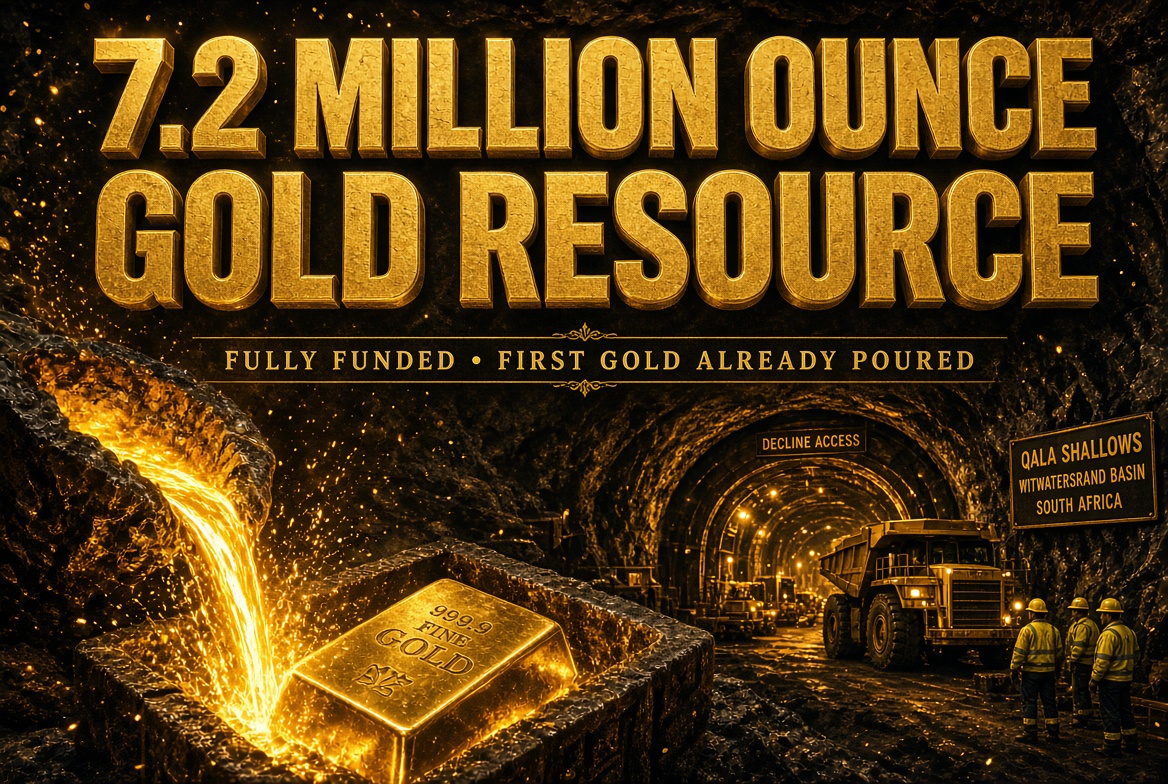
The company controls a substantial gold resource base of approximately 7.24 million ounces at an average grade of 4.00 g/t gold. West Wits holds a 74% economic interest in the Witwatersrand Basin Project, with the remaining 26% held by its South African Black Economic Empowerment partner, Lilitha Resources.
The investment case has changed considerably over the past year. West Wits is no longer simply an exploration company with a large underground gold resource. Its Qala Shallows operation achieved its first gold pour on 17 March 2026, following years of geological studies, permitting, project financing, and underground mine development.
However, it is important to understand that West Wits remains in the early stages of production. The gold recovered during 2026 has come from underground development ore rather than sustained primary stoping operations.
As of September 2026, Qala Shallows had produced a cumulative 339 ounces of gold, comprising 227 ounces produced by the end of June and another 112 ounces during the September quarter.
The company’s production growth plan targets approximately 10,000 to 15,000 ounces in 2027, 42,500 ounces in 2028, and a steady state annual production rate of approximately 70,000 ounces in the first quarter of 2029.
The project has a published Definitive Feasibility Study (DFS), updated in July 2025, showing a 17 year mine life, approximately 944,000 ounces of recovered gold, and life of mine free cash flow of US$983 million at an assumed gold price of US$2,850 per ounce.
The DFS also estimates an after tax NPV at a 7.5% discount rate of US$500 million, an after tax IRR of 81%, and an all in sustaining cost (AISC) of approximately US$1,289 per ounce.
These economics are interesting because the company is using existing regional infrastructure and a toll treatment arrangement with Sibanye Stillwater, reducing the need to build and operate a new processing plant.
The strongest upside comes from four areas. The large gold resource base, relatively attractive projected production costs, financing secured for the initial production ramp up, and longer term expansion potential across the broader Witwatersrand Basin.
The biggest risks are equally clear. West Wits must still prove that Qala Shallows can achieve its planned production rates, maintain underground safety, control operating costs, manage its debt obligations, and convert more of its mineral resources into economically mineable reserves.
Projects / Location / MRE / Grades
Project 1: Witwatersrand Basin Project, South Africa (Flagship Gold Asset)
The Witwatersrand Basin Project is West Wits Mining’s primary asset, located in the Central Rand Goldfield of Gauteng Province, South Africa.
The project lies within the Witwatersrand Basin, a region that has historically produced more than 1.5 billion ounces of gold, representing approximately 22% of all gold ever mined globally.
The project includes several mineralised reef horizons, particularly the Kimberley Reef, Bird Reef, and Main Reef packages.
West Wits holds its interests through a South African corporate structure, including West Wits MLI (Pty) Ltd, with the company maintaining a 74% project interest.
The broader project includes Qala Shallows, Main Reef Package, Bird Reef East, Bird Reef Central, and Qala Deeps. The mining and exploration rights cover both established underground mining areas and extensions that may support future growth.
One of the project’s advantages is its location within an established mining region. Johannesburg and the surrounding Witwatersrand area provide access to experienced mining contractors, mining equipment suppliers, transportation networks, electricity infrastructure, and a substantial skilled labour pool.
This is particularly important for an underground mining operation because experienced personnel, specialist equipment, geological knowledge, and access to processing infrastructure can materially influence development costs and operating performance.
West Wits is not attempting to discover an entirely new gold district. Instead, it is attempting to economically develop remaining gold resources within one of the world’s best known gold mining regions.
Witwatersrand Basin Mineral Resource Estimate
The latest global JORC Mineral Resource Estimate was announced in February 2026.
| Resource Category | Tonnes | Gold Grade | Contained Gold |
| Measured | 14.08 Mt | 4.40 g/t | 1,991,000 oz |
| Indicated | 15.55 Mt | 4.04 g/t | 2,020,000 oz |
| Measured and Indicated | 29.63 Mt | 4.21 g/t | 4,012,000 oz |
| Inferred | 26.81 Mt | 3.75 g/t | 3,232,000 oz |
| Total | 56.44 Mt | 4.00 g/t | 7,244,000 oz |
Grade Feel
An average resource grade of 4.00 g/t gold is attractive for a large underground gold project.
The measured resource averages 4.40 g/t, while the indicated category averages 4.04 g/t. These are strong grades for a mineral resource of this size.
The approximately 4.01 million ounces already classified as measured and indicated also provide a relatively substantial higher confidence resource base.
However, there is an important distinction between the broader Witwatersrand Basin resource and the ore currently planned for extraction at Qala Shallows.
The Qala Shallows DFS models an average run of mine grade of approximately 2.98 g/t gold. Mining dilution, geological conditions, mine design, and economic cut off grades mean that the actual mined grade can differ considerably from the headline global resource grade.
For us, the geological scale and grade are major positives. The remaining challenge is converting the resource into reserves and translating the geological model into consistent underground gold production.
Project 1A: Qala Shallows Gold Mine (Stage 1 Production Asset)
Qala Shallows is the first operating mine within the broader Witwatersrand Basin Project.
The mine was officially opened in December 2025 and achieved its first gold pour in March 2026.
The mining operation is being developed using underground decline access and modern mechanised equipment. One important milestone occurred on 21 May 2026, when the 1 West Decline successfully connected with the historic 2 Level mining area.
This breakthrough provided access to previously developed underground stoping areas. The existing workings can be modified to accommodate modern trackless equipment, potentially saving substantial additional development time.
By the end of September 2026, total underground development had reached approximately 1,150 metres.
Monthly underground development advanced from 73 metres in July to 183 metres in August and 200 metres in September.
The company is targeting further increases toward approximately 600 metres of monthly underground development during 2027.
Surface infrastructure was approximately 61% complete at the end of September 2026, compared with 45% at the end of June.
The haulage road had been completed, while the pollution control dam, permanent ore handling facilities, and supporting infrastructure were progressing.
Gold bearing development ore is transported to Sibanye Stillwater’s Ezulwini processing plant under a toll treatment arrangement.
This is a significant advantage because West Wits does not need to build an entirely new processing plant for Qala Shallows.
The mine can focus capital expenditure on underground development, mining equipment, ore transportation, surface facilities, and operational readiness.
Qala Shallows Ore Reserves
The latest declared JORC ore reserve is:
| Reserve Category | Tonnes | Grade | Contained Gold |
| Proved | 1.10 Mt | 2.79 g/t | 99,205 oz |
| Probable | 3.49 Mt | 2.54 g/t | 284,730 oz |
| Total | 4.60 Mt | 2.60 g/t | 383,934 oz |
The declared ore reserve represents the higher confidence portion of the mineable gold inventory.
The DFS mine plan, however, considers approximately 1.03 million contained ounces, including mineral resources that have not been converted into reserves.
This distinction is very important. The published reserve base provides a foundation for mining, but the longer production schedule relies on additional mineral resources, including inferred material.
West Wits needs ongoing drilling, resource conversion, mine planning, and geological reconciliation to increase confidence in the longer mine life.
Qala Shallows Updated DFS Economics
The July 2025 DFS, prepared by Bara Consulting, is the principal technical and economic study supporting the Qala Shallows development.
The base case uses a gold price of US$2,850 per ounce and an exchange rate of approximately ZAR18 per US dollar.
| DFS Metric | Value |
| Mine life | 16.8 years |
| Total run of mine material | 10.7 Mt |
| Average mined gold grade | 2.98 g/t |
| Contained gold in mine plan | 1,026,000 oz |
| Metallurgical recovery | 92% |
| Total recovered gold | 944,000 oz |
| Average annual production | 56,000 oz |
| Steady state annual production | 70,000 oz |
| Steady state operating period | Approximately 12 years |
| Maximum annual production | Approximately 75,000 oz |
| Life of mine revenue | US$2.7B |
| Life of mine free cash flow | US$983M |
| C1 cash cost | US$1,063/oz |
| Life of mine AISC | US$1,289/oz |
| Steady state AISC | US$1,181/oz |
| Peak funding requirement in DFS | US$44M |
| Pretax NPV 7.5% | US$719M |
| After tax NPV 7.5% | US$500M |
| After tax IRR | 81% |
| Payback after peak funding period | 8 months |
| Payback from start of development | 3.3 years |
The economic results are attractive because the forecast operating costs are relatively low compared with the assumed gold price.
At US$2,850 per ounce, the difference between the assumed gold price and the life of mine AISC is approximately US$1,561 per ounce.
At US$6,000 gold, that simple margin increases to approximately US$4,711 per ounce.
At US$7,000 gold, it increases to approximately US$5,711 per ounce.
These are indicative margins before accounting for additional items such as tax, financing costs, corporate expenses, and possible changes in costs or royalties. The actual realised margin will also depend on future gold prices and the ability to achieve the DFS operating assumptions.
Another important positive is the relatively limited peak funding requirement outlined in the DFS.
The company estimated peak funding of approximately US$44 million for the Qala Shallows development plan. The broader financing arrangements secured in 2026 include additional provisions for working capital and cost overruns.
The updated DFS reported an 8 month payback period after the end of the peak funding period. This is not a forecast that shareholders will recover their investment within 8 months, nor does it mean the mine will become fully operational 8 months after its first gold pour.
The main investment attraction is that Qala Shallows combines an established gold district, a sizeable resource, relatively low forecast AISC, access to existing processing facilities, and a financed development program.
Project 2: Project 200 (Witwatersrand Basin Expansion)
West Wits’ longer term growth strategy is known as Project 200.
The objective is to evaluate a potential expansion of the broader Witwatersrand Basin Project toward approximately 200,000 ounces of annual gold production.
The proposed growth concept considers additional resources across the Kimberley, Bird Reef, and Main Reef systems, including areas beyond the initial Qala Shallows mine plan.
If successfully developed, the broader project could support substantially higher annual production and a longer operating life.
The company completed a preliminary scoping study during 2026, evaluating a conceptual 35 year mine plan.
However, an important limitation emerged from the study.
Approximately 74% of the mineral resources considered across the modelled mine life were classified as inferred, with some individual production years relying on more than 90% inferred resources.
Following consultation with the ASX, the company concluded that releasing the completed study as a formal production target and associated financial forecast would not meet the applicable disclosure requirements because of the high proportion of inferred resources.
This is a meaningful risk and should not be overlooked.
For now, the proposed 200,000 ounce annual production capacity must be treated as a conceptual growth objective rather than an established production forecast.
The next important step is additional drilling and technical work to convert more inferred resources into measured and indicated categories, followed by more advanced feasibility studies.
For us, Project 200 provides meaningful long term optionality, but it should not receive the same valuation confidence as Qala Shallows.
Until the company publishes a technically supported development schedule, capital expenditure estimate, operating cost forecast, and sufficiently reliable mine plan, we would apply a substantial discount to any proposed expansion value.
Project 3: Bird Reef Central Uranium and Gold Project
Bird Reef Central represents an additional exploration and development opportunity within the Witwatersrand Basin Project.
The project is located approximately four kilometres northwest of the Qala Shallows mine.
Its mineralisation is associated with the Bird Reef package, including the White Reef, which has historically been explored for gold, and the overlying Monarch Reef horizons that host uranium mineralisation.
The existing JORC gold resource is approximately 117,600 ounces at an average grade of 2.66 g/t gold.
| Resource Category | Tonnes | Gold Grade | Contained Gold |
| Measured | 0.04 Mt | 3.73 g/t | 4,500 oz |
| Indicated | 0.89 Mt | 2.51 g/t | 72,200 oz |
| Inferred | 0.44 Mt | 2.86 g/t | 40,900 oz |
| Total | 1.38 Mt | 2.66 g/t | 117,600 oz |
The Bird Reef Central gold resource is already included within the broader Witwatersrand Basin resource estimate and should not be added separately to the company’s 7.24 million ounce resource total.
The company has commissioned a 17 hole, 5,750 metre diamond drilling program, with drilling scheduled to begin by the end of November 2026.
The program is planned in three stages.
The first stage involves seven holes covering approximately 2,100 metres, primarily evaluating uranium mineralisation and determining whether sufficient information can be gathered to estimate an initial uranium mineral resource.
The second stage involves 8 holes covering approximately 2,900 metres, focusing on infill drilling and improving resource confidence.
The third stage involves two holes covering approximately 750 metres, testing extensions to the known mineralisation.
The main attraction is the possibility of developing a separate gold and uranium mining opportunity using knowledge and infrastructure associated with the existing Witwatersrand operations.
However, the uranium opportunity remains at the exploration stage. The company has not yet established a compliant uranium mineral resource estimate, uranium reserve, processing plan, or economic feasibility study.
Therefore, we would not assign a substantial uranium valuation until drilling confirms the mineralisation and provides a reliable basis for future development.
Project 4: Mt Cecelia Project, Western Australia (Non Core Optionality)
Mt Cecelia is an exploration project located in the Paterson Province of Western Australia.
The project is prospective for gold and copper mineralisation, within a broader region known for significant mineral deposits, including the Telfer gold and copper operation.
However, Mt Cecelia is no longer a core priority for West Wits.
On 29 April 2026, the company announced an agreement to divest the project to Aventine Resources Limited.
The proposed transaction includes approximately A$2 million in Aventine equity, a 1% net smelter returns royalty over future production, and up to A$1 million in additional milestone consideration.
The arrangement also provides Aventine with the ability to buy back part of the royalty under specified terms.
As of the September 2026 quarterly report, the proposed divestment remained conditional on the completion of certain requirements, including Aventine’s planned ASX listing.
This means the transaction should not yet be treated as completed or as cash already received.
For West Wits shareholders, the asset provides limited additional exploration and transaction optionality.
The main strategic benefit is that disposing of Mt Cecelia would allow management to concentrate its capital and operational resources on Qala Shallows and the broader Witwatersrand Basin Project.
Share Structure / Ownership / Insiders
Capital Structure
West Wits completed a ten for one share consolidation in April 2026, materially reducing the number of ordinary shares on issue.
Based on the latest available market information and company disclosures:
| Capital Structure Metric | Value |
| Basic shares outstanding, approximately November 2026 | 435.27M |
| Listed and unlisted options, August 2026 | 69.39M |
| Unlisted warrants | 16.69M |
| Performance rights | 0.25M |
| Indicative fully diluted shares | 521.60M |
| Share price, 6 November 2026 | A$0.360 |
| Basic market capitalisation | A$156.70M |
| Indicative fully diluted market capitalisation | A$187.78M |
| Cash, 30 September 2026 | A$17.1M |
| Cash following October debt drawdown, 7 October 2026 | Approximately A$36M |
| Senior debt drawn by 7 October 2026 | Approximately A$50M |
| Total Absa and Nedbank debt facilities | Approximately A$97M |
| Attributable interest in WBP | 74% |
Ownership / Insiders
According to West Wits’ 2026 annual report, directors and key management personnel held approximately 15.49 million ordinary shares at 30 June 2026.
This represented approximately 3.56% of the company’s ordinary shares outstanding at that time.
Some notable holdings included:
| Management / Director | Shares Held |
| Michael Quinert | 7,165,705 |
| Warwick Grigor | 3,047,663 |
| Simon Whyte | 2,232,224 |
| Rudi Deysel | 1,260,000 |
| Keith Middleton | 900,000 |
| Jac van Heerden | 886,117 |
| Total key management holdings | 15,491,709 |
The figures reflect the ownership disclosed in the annual report and may have changed subsequently.
The August 2026 shareholder register also identified several significant registered holders, including BNP Paribas Nominees, Citicorp Nominees, Wingfield Durban Deep LP, and ALE Property Investments.
Among the named registered holdings, Wingfield Durban Deep LP held approximately 4.65% of the ordinary shares, while DRDGOLD Limited appeared in the top twenty shareholder list with approximately 1.10%.
People / Management
Rudi Deysel, Managing Director and Chief Executive Officer
Rudi Deysel is a mining engineer with experience in underground mining, open pit operations, and multiple commodities.
His background includes experience with major mining and engineering businesses such as Anglo American and Murray & Roberts, alongside previous exposure to Galiano Gold.
He became West Wits’ Chief Executive Officer in December 2024 and subsequently joined the board as Managing Director in 2025.
His mining background is highly relevant because Qala Shallows is an underground operation that requires disciplined mine development, geological control, engineering, safety management, and production planning.
Michael Quinert, Executive Chairman
Michael Quinert is an experienced commercial lawyer with a long history of involvement in Australian listed companies, particularly in capital markets, corporate governance, and resource sector transactions.
His background includes advising publicly listed mining companies on corporate financing, compliance, acquisitions, and commercial arrangements.
Quinert has served as a director of several listed and unlisted businesses and has been associated with West Wits for many years.
Jac van Heerden, Non Executive Director
Jac van Heerden is a mining engineer with an MBA and more than two decades of mining operations and project development experience.
He has worked across South Africa, Zimbabwe, and the Democratic Republic of Congo, with experience in underground and surface mining operations involving gold, platinum group metals, copper, and cobalt.
Before joining West Wits, he served as President of ERG Africa’s copper and cobalt mining business, overseeing a substantial operating workforce.
Van Heerden previously served as Managing Director of West Wits before transitioning to a non executive role in 2023.
Warwick Grigor, Non Executive Director
Warwick Grigor is an experienced mining analyst, financier, and corporate adviser.
He founded Far East Capital, a specialist investment and advisory business focused on mining companies.
He was also the founding Executive Chairman of Canaccord Genuity Australia, providing him with extensive experience in mining finance, equity markets, company valuations, and investor relationships.
Keith Middleton, Non Executive Director
Keith Middleton has more than 20 years of involvement in the mining and resource sector, including corporate advisory, capital markets, project development, and governance.
He previously served as Managing Director of American Rare Earths, where he was involved in expanding the company’s exploration and development portfolio, capital raising, permitting, and the delivery of mineral resource estimates.
His earlier involvement with other listed resource companies provides additional experience in corporate restructuring and project financing.
Simon Whyte, Chief Financial Officer and Joint Company Secretary
Simon Whyte is a chartered accountant with experience in mining, commodities, logistics, financial reporting, and business transformation.
His professional background includes experience with Ernst & Young and BP Australia.
His role is particularly important because West Wits has entered a more complex financial phase involving institutional debt facilities, project development spending, corporate reporting, and future operating cash flow management.
Sephela Makete Thema, Head of Operations, South Africa
Makete Thema holds qualifications in mining engineering, including a Bachelor of Science in Mining Engineering and a Master of Science in Engineering from the University of the Witwatersrand.
His previous professional experience includes Fraser Alexander and Sibanye Stillwater.
His responsibilities are closely connected with underground mine operations, operational execution, and workplace safety.
Lindiwe Magidimisa, Head of Projects and Business Development, South Africa
Lindiwe Magidimisa has an engineering and business background, including chemical engineering qualifications, postgraduate industrial engineering studies, and an MBA.
Her previous experience includes leadership and project related roles associated with De Beers, Eurasian Resources Group, Deloitte, and Anglo American.
Tozama Kulati Siwisa, MLI Executive Director and Head of Corporate Affairs, South Africa
Tozama Kulati Siwisa has experience in corporate affairs, stakeholder engagement, environmental and social governance, and transformation initiatives.
Her previous background includes stakeholder relations responsibilities at Lonmin.
She was recognised as a Rising Star by the Australia Africa Minerals and Energy Group in 2025.
Overall Management Assessment
We consider West Wits’ management team relatively strong in terms of operating experience, project development, capital markets, and familiarity with South African mining.
Several members have worked with established mining organisations, including Anglo American, Sibanye Stillwater, ERG Africa, De Beers, Murray & Roberts, and Galiano Gold.
The combination of technical mining personnel and experienced financing professionals is encouraging.
However, the company should not yet receive full credit for successfully delivering Qala Shallows to steady state operations.
The first gold pour is a meaningful achievement, but producing a few hundred ounces from development material is fundamentally different from operating a mine that consistently produces 70,000 ounces annually.
Risks / Catalysts / Timeline
Key Risks
| Key Risk | Why It Matters |
| Production Ramp Up Risk | Qala Shallows has produced initial gold, but primary stoping and commercial production remain ahead. The company must prove it can expand underground development and maintain reliable ore delivery. |
| Mineral Resource Conversion Risk | The broader resource totals 7.24Moz, but Qala Shallows currently has only approximately 384,000oz of declared ore reserves. Its longer mine plan relies on additional mineral resources, including inferred material. |
| Project 200 Study Risk | The conceptual 35 year expansion plan relied heavily on inferred mineral resources. It cannot be treated as a reliable 200,000oz annual production forecast until more technical work and resource upgrading are completed. |
| Underground Mining Risk | Ground conditions, water management, ventilation, equipment reliability, grade dilution, and access development can all affect operating performance. |
| Mine Safety Risk | The June 2026 fatal mud rush incident demonstrates the seriousness of underground operating hazards. Further incidents could affect workers, operations, regulatory compliance, and project schedules. |
| Cost Inflation Risk | The DFS AISC of US$1,289/oz is attractive, but actual costs may differ because of labour expenses, fuel, electricity, mining contractors, equipment, transportation, and currency fluctuations. |
| Financing and Debt Risk | The project has secured substantial financing, but interest costs, debt covenants, repayment obligations, and unexpected funding requirements could pressure the company during the ramp up. |
| Dilution Risk | Approximately 521.6M indicative fully diluted shares represent a meaningful potential increase over the basic share count. Additional capital raising remains possible. |
| Jurisdiction Risk | South Africa has a well established mining industry, but regulatory requirements, electricity supply, labour relations, taxation, social obligations, and policy changes require ongoing monitoring. |
| Processing Dependence | Qala Shallows depends on a toll treatment arrangement with Sibanye Stillwater’s Ezulwini plant. Changes to availability, processing terms, costs, or recovery could affect margins. |
| Ownership Structure Risk | West Wits owns 74% of the project rather than 100%. The remaining economic interest belongs to its local partner, reducing the share of project cash flows attributable to ASX shareholders. |
| Commodity Price Risk | Gold is the primary revenue driver. Lower gold prices would reduce margins, cash flow, project valuation, and the company’s financial flexibility. |
| Currency Risk | Revenue is primarily linked to US dollar gold prices, while many operating costs are denominated in South African rand, and the company is listed in Australian dollars. Exchange rate movements can materially affect results. |
Mine Safety Considerations
On 10 June 2026, a contractor employee died following a mud rush incident at Qala Shallows.
The company notified South African regulators and suspended affected operations during the investigation.
According to the company’s subsequent disclosures, the investigation concluded with no adverse findings against West Wits, and operational restrictions were lifted.
However, this event highlights the importance of water management, ground control, underground safety systems, contractor supervision, and workforce training.
The company has since emphasised its safety programs, including management engagement with employees and a Zero Harm initiative.
Catalysts
| Timeline | Key Milestone |
| Late 2026 | Continued underground development at Qala Shallows |
| November 2026 | Planned start of Bird Reef Central uranium and gold drilling |
| Late 2026 | Continued preparation of the historic 2 Level stoping areas |
| Early 2027 | Planned commissioning of permanent bulk grid power connection |
| February 2027 | Scheduled commencement of primary stoping production |
| First Half 2027 | Initial drilling results from Bird Reef Central |
| 2027 | Further underground development and increased ore production |
| Third Quarter 2027 | Targeted completion of critical surface infrastructure |
| Fourth Quarter 2027 | Targeted commencement of commercial production |
| Full Year 2027 | Targeted gold production of 10,000 to 15,000oz |
| 2028 | Targeted gold production of approximately 42,500oz |
| 2028 | Potential additional resource conversion and technical studies |
| First Quarter 2029 | Targeted steady state production rate of 70,000oz annually |
| 2029 onward | Possible stronger operating cash flow and debt reduction |
| Longer Term | Further study and possible staged development of Project 200 |
| Longer Term | Potential development of Bird Reef Central gold and uranium opportunities |
Expected Timeline to Full Production
| Year / Period | Focus | What It Means |
| 2026 | Initial production and underground development | First gold has been achieved. The focus is increasing underground access, developing surface infrastructure, and preparing for primary stoping. |
| Early 2027 | Primary stoping begins | The mine is scheduled to transition from development ore toward regular underground production. |
| 2027 | Commercial production | Management targets 10,000 to 15,000oz of annual production, with commercial production expected in the fourth quarter. |
| 2028 | Production expansion | Gold production is targeted to increase to approximately 42,500oz. Actual operating performance should begin to provide stronger evidence of project economics. |
| First Quarter 2029 | Steady state production | Management targets an annualised production rate of approximately 70,000oz. |
| 2029 onward | Cash flow optimisation | Potential improvements in operating margins, debt repayment, and exploration spending as production stabilises. |
| Longer Term | Project 200 growth | Further studies may establish whether the broader resource base can support additional production beyond Qala Shallows. |
Valuation
All Projects Valuation Table
The following table applies our illustrative FCF multiples to the estimated attributable average annual free cash flow.
It converts US dollar values into Australian dollars using the stated exchange rate, adds the A$32 million base optionality allowance, deducts the simplified A$14 million net debt proxy, and divides the resulting equity value by approximately 521.6 million fully diluted shares.
| Gold Price | FCF Multiple | Implied Equity Value (AUD) | Implied Value Per Share | Upside vs A$0.360 |
| US$6,000/oz | 10 | A$2.04B | A$3.91 | +987% |
| US$6,000/oz | 15 | A$3.05B | A$5.85 | +1,526% |
| US$6,000/oz | 20 | A$4.06B | A$7.79 | +2,064% |
| US$7,000/oz | 10 | A$2.48B | A$4.76 | +1,222% |
| US$7,000/oz | 15 | A$3.71B | A$7.12 | +1,879% |
| US$7,000/oz | 20 | A$4.95B | A$9.49 | +2,535% |
These are mathematical scenario outputs rather than credible current share price targets.
The main limitation is the application of relatively high FCF multiples to the average cash flow of a finite life underground mine.
A 10, 15, or 20 times multiple may be appropriate for comparing hypothetical valuation sensitivities, but it can significantly overstate fair value when mine depletion, development delays, discount rates, financing costs, and operating risks are not fully reflected.
A proper valuation would discount each year’s expected free cash flow separately and account for production timing, remaining capital expenditure, financing obligations, tax, royalties, and potential future dilution.
We would therefore not use the very large percentages in this table as the primary basis for an investment decision.
Summary & Quick Scorecard
| Category | Points | Overall |
| Company Overview | Stock ticker: WWI (ASX), WMWWF (OTCQB). Main metal: Gold. Secondary exposure: Uranium and copper exploration. Project phase: Early gold producer, commercial ramp up stage. Principal country: South Africa. | Emerging Producer |
| 1. Management | Previous mine development and production experience: Yes. Exploration to development experience: Yes. Major mining company experience: Yes, including Anglo American, Sibanye Stillwater, De Beers and ERG Africa. Capital markets experience: Yes. | Strong |
| 2. Projects | High grade resource: Yes, 4.00 g/t global average. MRE size: Yes, 7.24Moz gold. Optionality: Yes, Project 200 and Bird Reef Central. Existing processing infrastructure: Yes, toll treatment arrangement. Reserve conversion: Further work required. | Strong |
| 3. Cost Structure | DFS life of mine AISC: US$1,289/oz. Steady state AISC: US$1,181/oz. Relatively low processing infrastructure requirement: Yes. Actual commercial operating costs: Not yet established. | Strong |
| 4. Share Structure Discipline | Basic shares: Approximately 435.27M. Indicative fully diluted shares: Approximately 521.60M. Basic market cap: A$156.70M. Fully diluted market cap: Approximately A$187.78M. Significant outstanding options and warrants: Yes. | Strong |
| 5. Insider / Ownership | Key management share ownership: Approximately 3.6% Institutional financing participation: Yes. Aligned insider: 7-8%. | Weak |
| 6. Location | Principal country: South Africa. Province: Gauteng. District: Central Rand Goldfield, Witwatersrand Basin. Geological quality: Exceptional established gold district. Investment jurisdiction assessment: Tier 2, reflecting meaningful operating and sovereign risks. | Good |
RT Rating, Commentary
West Wits Mining Limited is on the watchlist, with rating 4 out of 5 stars.
West Wits is one of those gold companies where the underlying resource looks considerably larger than the initial production operation.
The company controls a 7.24 million ounce gold resource averaging 4.00 g/t, with approximately 4.01 million ounces already classified as measured and indicated. Those are meaningful numbers for an emerging producer.
What makes the opportunity interesting is that the company has already moved beyond exploration and achieved its first gold production.
Qala Shallows is now a genuine operating development project, with underground access established, toll treatment available, a published DFS, and institutional debt financing secured.
The strongest positive, in our view, is the projected cost structure.
At an estimated AISC of US$1,289 per ounce, the mine could generate attractive margins in a strong gold price environment. If gold prices remain substantially above the level assumed in the DFS, West Wits has considerable operating leverage.
Another important strength is the size of the broader resource base.
The Qala Shallows mine plan represents only part of the Witwatersrand Basin opportunity. Project 200 and the additional Bird Reef prospects provide a possible longer term path toward a larger mining business.
However, we need to be careful here.
Firstly, their insider considerably low. Then, a seven million ounce mineral resource does not automatically mean the company can economically produce seven million ounces of gold.
The company’s current reserve base is considerably smaller, and the Project 200 scoping study relies too heavily on inferred resources to support a sufficiently reliable production forecast.
The other major consideration is South Africa.
The Witwatersrand Basin is one of the greatest gold regions ever discovered, but investors must still account for country specific operating risks, regulatory requirements, labour issues, electricity supply, mine safety, and currency exposure.
The company also owns only 74% of its primary project. This is important when calculating the value that actually belongs to ASX shareholders.
Join RockeTeller
At RockeTeller, we do not just chase stories. We hunt for rare mining stocks with the right mix of criteria. Every company is tested through our specific checklist before it earns a place on our watchlist.
We ask the hard questions that matter most: Is this a stock we would actually back, what is the realistic target price, and how strong is the risk reward?
Our watchlist is reserved for high quality setups with real multibagger potential, not hype.
If you want serious deep dive research with conviction, subscribe to RockeTeller.com.