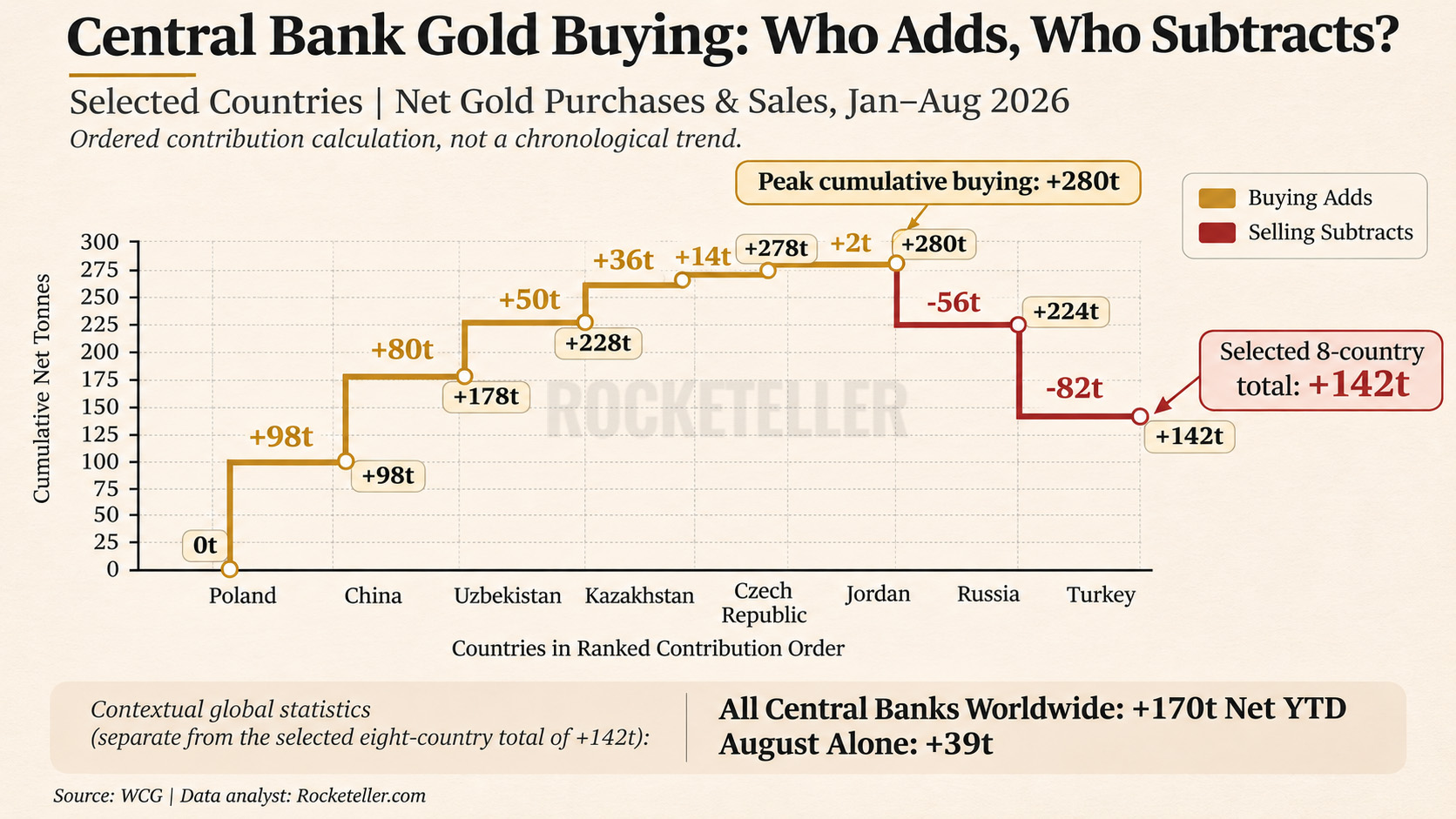
Who’s buying gold while everyone else debates the next market crash? Central banks. And the numbers tell an interesting story. From January through August 2026, Poland added 98 tonnes, China bought 80, and Uzbekistan followed with 50. Add Kazakhstan, the Czech Republic, and Jordan, and these six countries collectively piled up 280 tonnes.
But hold on. Not everyone was shopping. Russia sold 56 tonnes, while Turkey offloaded 82. That brings the combined net purchases of these 8 selected countries down to 142 tonnes. The chart is a scoreboard of contributions, not a timeline. And globally? Central banks recorded 170 tonnes of net buying, including 39 tonnes in August alone.
So why does this matter?
Central banks buy gold for reasons that go beyond chasing returns. They may want to diversify reserves, reduce dependence on individual currencies, or protect against financial and geopolitical shocks. Their purchases can provide a meaningful source of demand, especially when investment sentiment turns sour.
Now, here’s the twist. Strong central bank demand can support gold prices, but it doesn’t guarantee a rally. Real interest rates, the US dollar, investor flows, and mine supply still matter.
And for the broader commodity market? Gold strength can lift sentiment toward silver and mining shares, but copper and oil follow different demand engines, including industry and global growth.
The takeaway? Follow the central banks. Just don’t mistake one powerful buyer for the entire commodity cycle. Gold is telling a story about reserves and risk, not necessarily the next industrial boom.