Our main theme for 2026 is simple: real assets.
That is the big bet. The center of the map. The lane we believe deserves the closest attention as the next chapter of the market unfolds.
So how do we analyze it?
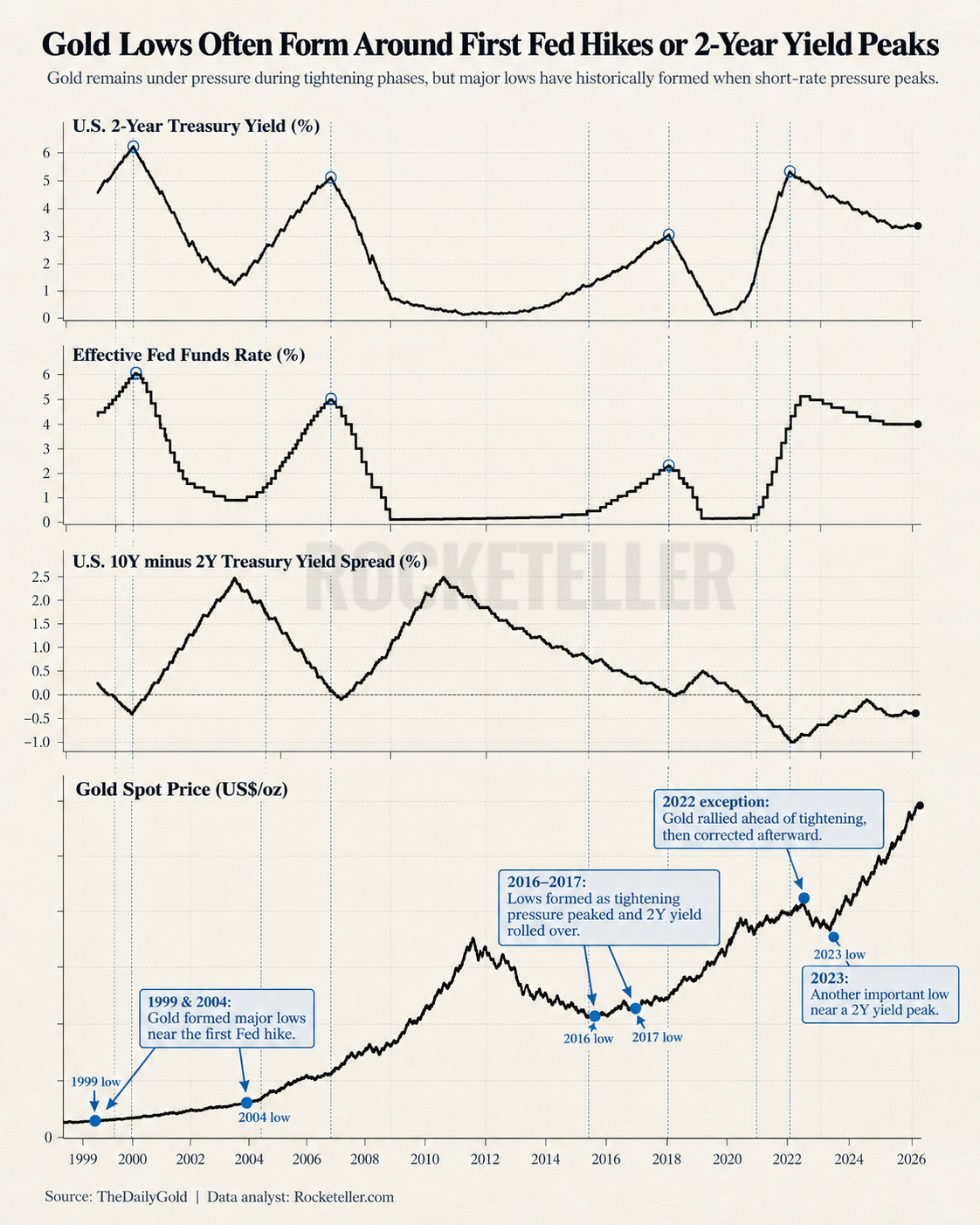
Well, 4 pillars. Macro, cycles, ratios, technical timing. We want to cut this post short, but we did elaborate deep our methodology and approach of investing, read more here.
Think of them as four different lenses looking at the same battlefield. Macro tells us what kind of world we are operating in. Cycles help us understand where we may be in the bigger rhythm. Ratios reveal relative value beneath the surface. And technical timing helps us avoid showing up too early to a party that has not started, or worse, arriving just as the lights come on.
No framework is perfect. Markets are still markets, messy, emotional, occasionally irrational, and fully capable of humbling anyone with too much confidence. But a strong framework gives you something most people never have: a clear lens for interpreting the chaos.
And in a market full of noise, clarity is an edge.
So with that, let the charts do the talking.

Historical data suggests that commodity prices tend to peak roughly every 60–65 years.
These long cycles are often driven by large macro forces such as wars, debt expansion, inflationary regimes, and industrial booms.

We do have our own roadmap, take a look the chart above.
So what’s the conclusion?
Our base case is straightforward: the next major crash or recession likely lands in 2026, 2027, or 2028.
That has been our working thesis, and we have positioned around it accordingly. In fact, we began building positions back in 2023 and 2024, which means we believe we are already sitting in a strong position going into this window.
Now for those of you just getting started in 2026, the obvious question is: what now?
From our perspective, there are two main ways to play it.
The first is to wait. Sit tight, hold your fire, and look for the crash to unfold in 2026, 2027, or 2028. Then, once prices have been smashed and the panic is thick in the air, start building positions from the bottom.
That approach sounds great in theory. In practice, it is harder than it looks. Bottoms are messy, emotional, and rarely come with a giant sign that says, “Congratulations, this is the exact low.”
The second approach is to dollar-cost average your way in.
And if you ask us, that is the better route.
But it is just not for all. If you can handle massive drawdown, yes it is for you. If not, just stick after 2027, 2028.

What industry will we want to be in?
The chart above compares Energy stocks (XLE) to Technology stocks (XLK). It’s breaking just in time.
It’s simple, commodities.
Energy, gold, silver, copper, iron, agriculture, miners.
But you guys love AI/Tech so much? Fine, play the “pick and shovels” strategy. Which are copper, silver, uranium, aluminium, rare earths.

See the chart above, one of the world’s leading uranium producers company, Cameco.
We bought it in 2023/2024.
We not calling for entry now, just to share. The stock has formed a long cup and handle pattern.
Every company has its own fundamentals and risks, so deeper analysis is always necessary before making an investment decision.
Our goal here is not to predict the future with certainty.
We just want to provide a structured framework that might offered you asymmetrical risk to reward in 2026.
At the end of the day, the risk is always yours.
If you’d like to explore our full investment approach in greater detail, you can access our full report here.