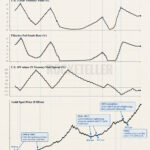
This chart takes three secular Gold to Dow cycles and puts them on the same indexed scale, so you can compare them without getting distracted by raw numbers. In other words, it strips away size differences and asks a cleaner question. How far did each cycle travel relative to its own peak? That makes the picture much easier to read. The first cycle from the late 1960s to early 1980s was the monster move. The second cycle from 2002 to 2013 was still powerful, but clearly smaller. The current cycle, starting in April 2024, is much shorter and still nowhere near the full historical extremes.
That is the big macro takeaway. Gold may not be late. It may still be early.
Why does that matter for commodities? Because gold usually does not wake up for no reason. It tends to lead when the market starts getting nervous about inflation, debt loads, currency credibility, real interest rates, or the durability of growth. Gold is often the first asset in the room to sense that the old script is getting shaky. When it starts outperforming stocks, it can be a signal that capital is beginning to rotate away from pure financial assets and back toward hard assets.
That shift can ripple through the commodity complex. First gold strengthens. Then silver often starts moving with more torque. Then miners begin to catch attention. Then broader resource names can benefit if the market starts pricing in tighter supply, sticky inflation, or renewed interest in tangible assets. So this image is not just about gold versus the Dow. It is really about whether a larger hard asset cycle may be quietly building underneath the surface.